In this article (12)
What did the state estimate Zone 0 would cost?
The emergency rule package the Board sent to the Office of Administrative Law carried an economic and fiscal impact statement (Form STD 399). According to engineer Nate Wittasek, P.E., who has written about the filing twice (September 1 and November 9, 2026), it put compliance at:
- $960.54 per typical affected homeowner;
- $1.738 billion statewide over the life of the rule;
- zero ongoing annual cost.
We have not seen the filing, so these figures are secondhand. As a rough check, by our own arithmetic $1.738 billion divided by $960.54 is about 1.8 million homeowners. That is in the same range as CAL FIRE’s estimate, cited in the Board’s Zone 0 FAQ (September 17, 2025), of 1.25 million structures in the State Responsibility Area and 870,000 in local Very High Fire Hazard Severity Zones.
Wittasek argues the estimate is low. He says it leaves out follow-on costs, such as building a wall or fence to replace a privacy hedge, and repairs after removal. He also calls the $960.54 figure the only official estimate in the regulatory record. Both points are his view.
How much will Zone 0 cost homeowners in practice?
It depends almost entirely on what is within 5 feet of your house today. The rule (14 CCR 1298.04 and 1299.03) splits into two kinds of work:
- Cleanup and landscaping. Clearing roof and gutters, removing bark mulch, moving firewood, trimming trees, and clearing plants from under eaves and near windows and doors. Much of this is work an owner can do. Replacing mulch with rock or pavers costs money; one vendor (EmberPro, September 25, 2026) quotes $3 to $8 per square foot for a hardscape swap, without stating a basis.
- Construction. Replacing a wood gate or fence section attached to the house, and moving or replacing a wood shed under 120 square feet that sits in the zone.
For Los Angeles, the nonprofit MySafe:LA (October 23, 2026) ran planning scenarios on the roughly 155,000 parcels in LAFD’s Very High zone brush clearance inspection program: $1,500, $2,500 or $3,200 per parcel, for citywide totals of $232.5 million, $387.5 million or $496 million. It called $3,200 “a plausible preliminary planning assumption” and said the numbers are not official estimates. The same vendor that quotes the hardscape price puts a full Zone 0 retrofit at $3,000 to $15,000, again without a basis.
What does the fence and gate part cost?
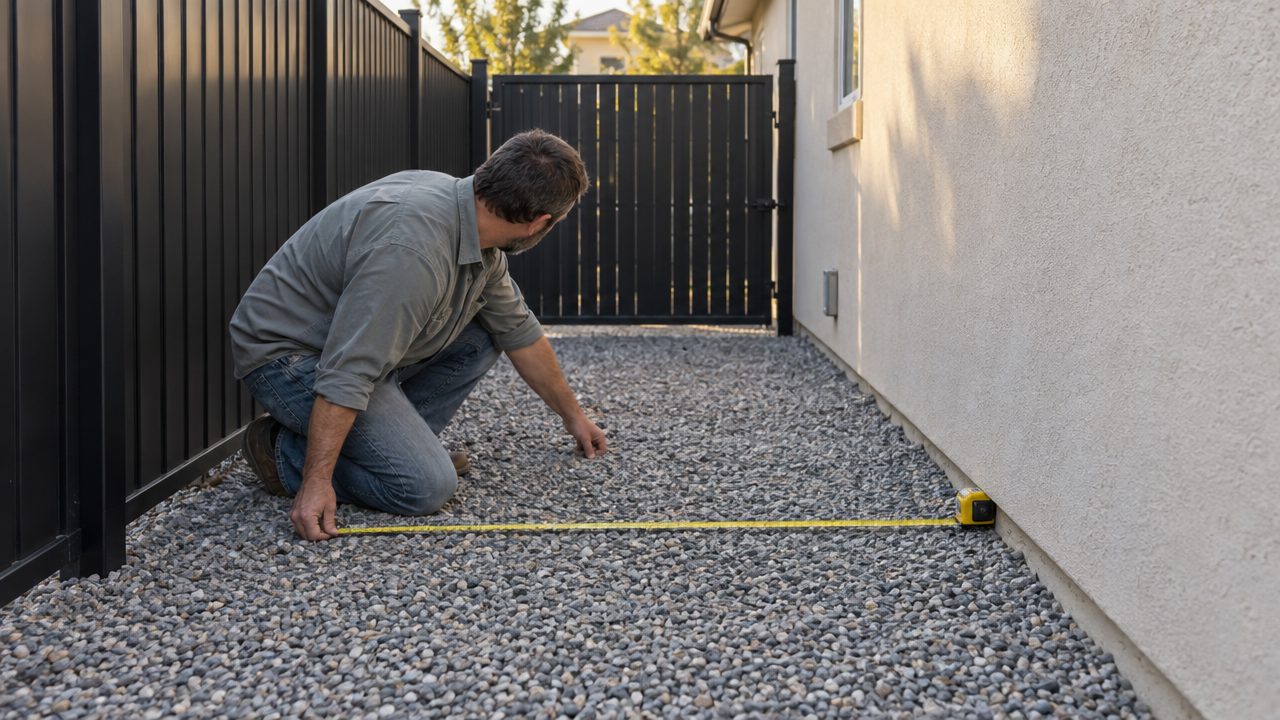
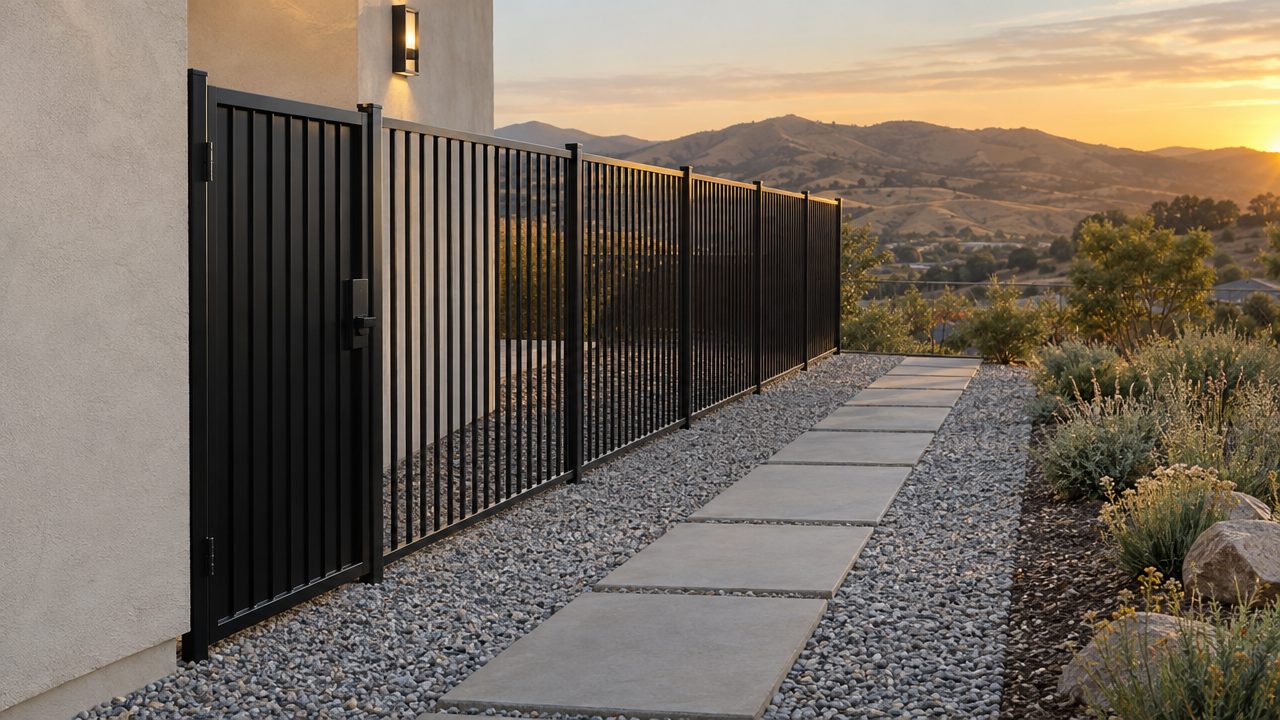
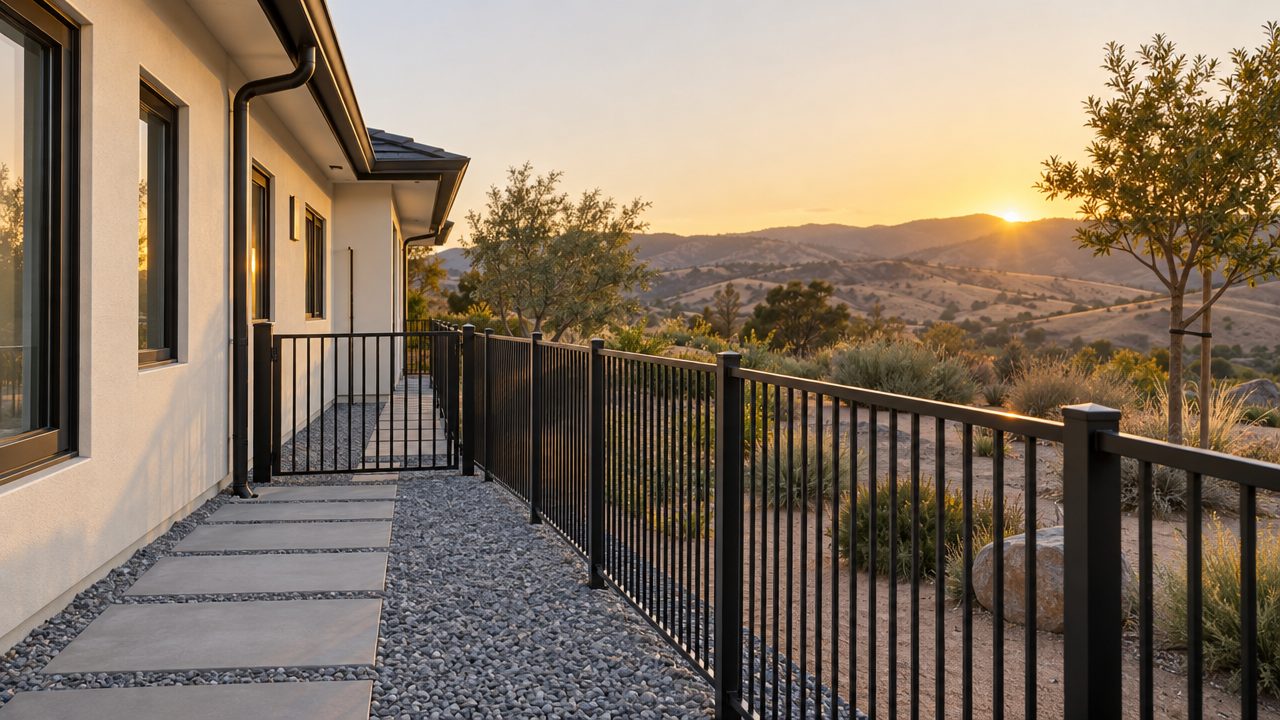
The fence rule is narrow. Any fence or gate attached to the house, or within 1 foot of it, needs a 5-foot noncombustible span at the house end, and you cannot build a new combustible fence within 5 feet (1298.04(b)(8)-(9); 1299.03(d)(8)-(9)). Existing wood fence beyond that can stay and be repaired with wood. So the purchase is one gate or one 5-foot panel per point where a fence meets the house. The full rule is covered in Zone 0 fence requirements.
Published prices we found, all pages accessed November 10, 2026:
| Item | Price | Source | Page date |
|---|---|---|---|
| Aluminum Zone 0 section only (5 to 10 ft), no gate | $2,000 to $2,500 | JJ’s Fence Company, San Diego County | Undated; cites San Diego’s Rev. 4/22/2026 guidelines |
| Zone 0 section plus gate | From $3,000 | JJ’s Fence Company | Undated |
| Full side-yard run (30 to 50 ft) | $2,500 to $5,000 | JJ’s Fence Company | Undated |
| Full aluminum perimeter | $5,000 to $15,000+ | JJ’s Fence Company | Undated |
| Noncombustible section at the house | $40 to $100 per linear ft, no basis given | EmberPro | September 25, 2026 |
| Noncombustible gate | $500 to $2,000 per gate, no basis given | EmberPro | September 25, 2026 |
| Aluminum fence, general | $32 to $70 per linear ft, citing general pricing guides | Globus Gates blog | February 16, 2026 |
| Removing old fence | $3 to $9 per ft, citing a cost guide | Globus Gates blog | February 16, 2026 |
Wittasek also cites a published San Diego County compliance example that came to $7,754 in total, of which the gate replacement alone was $3,556 (September 1, 2026). We have not seen that example directly.
Two cautions. First, per-foot prices undersell small jobs: a 5-foot section at $70 a foot would be $350, but the San Diego price for that job starts at $2,000. Our explanation, not the contractor’s, is that a small job carries fixed costs (a crew visit, a new post at the house, and the joint with the old fence) that a per-foot average spreads over a longer run. Second, these are a few vendors’ published prices, mostly in San Diego County. Get local quotes.
What drives the cost up or down?
- Number of attachment points. Most of the money is per point where a fence meets the house. A house with a side-yard fence on each side has two. No survey has measured how many a typical California home has.
- Gate or panel. In the San Diego pricing above, adding a gate moves the starting price from $2,000 to $2,500 for the section alone to $3,000.
- What is already there. Wood and vinyl need work. The IBHS Wildfire Prepared Home checklist (2026) tells owners to replace “wood or vinyl fencing within 5 feet of the home with noncombustible fencing (e.g. metal).” An existing metal fence may already qualify, but the rule’s test is ASTM E136, so check with your fire agency if you are unsure.
- The house end. Ask the contractor how the new post will be fixed at the house (anchored to the wall or set in the ground beside it) and whether stucco or siding repair is included.
- Whether you replace more than you must. The state rule asks for 5 feet. Some owners replace the whole side run at the same time; in the San Diego pricing above that is $2,500 to $5,000, against $2,000 to $2,500 for the section alone.
- Local rules. San Diego’s guidelines (Rev. 4/22/2026) go beyond the state text and prohibit parallel combustible fencing in Zone 0 that forms a continuous fuel pathway, with narrow exceptions for some vinyl and fire-retardant-treated wood. A parallel wood fence close to the house can turn a single-gate job into a longer run there.
If you are buying aluminum, ask for the product’s ASTM E136 test report. The rule defines noncombustible by that test (1298.02(f); 1299.02(g)). The Aluminum Association’s paper “Fire Safety of Aluminum and Its Alloys” reports that nine alloys, including 6063, and commercially pure aluminum all passed E136 in tests in 2011 and 2020. It says a different standard, ASTM E2652, is the one whose scope excludes materials that melt. A product-specific report gives an inspector something to accept.
Who pays for Zone 0?
The owner. Public Resources Code 4291(a) and Government Code 51182(a) put the defensible space duty on “a person who owns, leases, controls, operates, or maintains” the building; that wording predates SB 504 (2024), which kept it. The Board’s September 2026 guidance adds that state law only requires owners to manage fuels on their own property.
We found no state program that pays for Zone 0 compliance in general. SB 504 told the Board that its regulations “shall allow the staging of work for existing structures” and “address the costs of compliance.” The rule stages the work through phased deadlines: existing homes get 3 years for most cleanup and 3 to 5 years for fences, gates and plant buffers, and the Board’s August 2026 summary says the phasing is meant to give homeowners time “to make changes effectively and affordably.” Some public money exists, but only in specific places (next section).
The rule does not shift cost at sale. A point-of-sale version depended on SB 326, which was vetoed on October 11, 2025; the veto was sustained on March 2, 2026.
Are there grants for Zone 0 work?
Only locally, and none we found pays for fences statewide:
- California Wildfire Mitigation Program (Cal OES and CAL FIRE). Open only to owners inside named project areas. On November 10, 2026 the homeowner page listed El Dorado (Weber Creek), Lake (Kelseyville Riviera), Siskiyou (West Mount Shasta) and Tuolumne (Mira Monte, Ponderosa Hills, Sunrise) as accepting applications, and San Diego and Shasta areas as not accepting. The page does not list fences as a covered measure.
- Sleepy Hollow Fire Protection District (Marin). Its Zone Zero pilot program removes combustible materials, “such as the portion of a wooden fence connected to a structure,” at no cost. The page does not mention gates or replacement fencing.
Check with your fire district and county; programs like these change each budget year.
Can insurance discounts offset the cost?
Partly, and the discounts exist now, before any Zone 0 rule is in force. The Department of Insurance’s Safer from Wildfires page lists a “5 foot ember resistant zone, including fencing” as a discount action and says replacing wood fencing connected to the home with metal is “critical.” The underlying rating regulation (10 CCR 2644.9) names noncombustible materials within 5 feet of the building, “including fences and gates,” among the mitigation measures it lists for insurers’ rating plans. In an October 15, 2025 letter to the Board, Commissioner Lara wrote that these discounts “can range from 4% to over 40% of the total premium.”
Examples of what insurers publish:
- California FAIR Plan (from November 15, 2025): up to 16.4% off the wildfire portion of a Dwelling Fire premium across 12 discounts. One item requires only noncombustible materials, “including fences and gates,” within 5 feet of the dwelling.
- Mercury: wildfire-peril discounts from 12.5% to 45% across three tiers, each of which requires only noncombustible materials within 5 feet, naming fencing and gates.
Compliance does not guarantee a discount or an offer of coverage; each insurer applies its own filed rating and verification (Insurance Business, August 20, 2026). More in Zone Zero insurance discounts.
When will you have to spend the money?
Not until the rule takes effect, and no effective date has been set. Once it does, new homes comply immediately. For existing homes, fence and gate work is due in 3 years, or up to 5 on a local timeline, in city and county Very High zones (1298.04(c)(4)), and in 5 years, or not less than 3 on CAL FIRE’s timeline, in the SRA (1299.03(e)(4)). Vendor pages that cite a 2026 or 2027 state deadline are wrong.
Local rules can come sooner. San Diego’s guidelines (Rev. 4/22/2026) require full compliance, including fences and gates, by February 28, 2029. Our step-by-step guide is at how to comply with Zone Zero, and the law and status are at Zone Zero California law.
What we don’t know yet
- The final text. The Mountain Democrat reported on October 28, 2026 that Board staff expected to bring edits back to the Board on November 5 before resubmitting the package to OAL. That report is unconfirmed, and we have not seen a revised version.
- How many California homes have a wood or vinyl fence attached to the house. No survey exists, and it is the biggest unknown in any total.
- Whether published prices hold as more installers offer Zone 0 sections and deadlines approach.
Questions people ask
How much will Zone Zero cost homeowners?
The state's economic impact statement for the rule reportedly put compliance at $960.54 for a typical affected homeowner and $1.738 billion statewide; those figures come from engineer Nate Wittasek's September and November 2026 reports on the filing, not from the filing itself. MySafe:LA's planning scenarios for Los Angeles used $1,500 to $3,200 per parcel. A home with a wood gate or fence attached to the house will likely spend more than the state figure: one San Diego County contractor publishes prices starting at $3,000 for an aluminum Zone 0 section plus gate. The rule was adopted in August 2026 but was not in effect as of November 10, 2026.
Who pays for Zone Zero?
The property owner, or whoever leases, controls, operates or maintains the building; Public Resources Code 4291 and Government Code 51182 put the defensible space duty on that person. We found no state program that pays for Zone 0 work in general. A few local and state grant programs cover specific neighborhoods, and insurance discounts can offset part of the cost over time. The state rule was not in effect as of November 10, 2026.
Keep reading
 GuideHow to comply with Zone Zero in California
 GuideZone 0 fence requirements in California
 GuideZone Zero insurance discount: what California insurers give
 GuideZone Zero in California: the law, who it covers, deadlines
 How much to replace a side gate: wood vs metal prices
More in Cost
Sources
- N. Wittasek, Zone 0 Was Priced at $960 a House (reports the state's Form STD 399 figures), .
- N. Wittasek, A Tax That Never Had to Call Itself One (Form STD 399 figures), .
- Board of Forestry Zone 0 FAQ (structure counts), hosted by the City of San Diego, .
- MySafe:LA, Zone 0 could cost Los Angeles property owners nearly $500 million, .
- JJ's Fence Company, partial fence replacement for Zone 0 (San Diego County pricing, undated; accessed), .
- EmberPro, Zone 0 regulations: what California homeowners must do to comply, .
- Globus Gates, aluminum fence installation in California, .
- Board of Forestry, Zone 0 regulation summary and rule text (14 CCR 1298.04, 1299.03), as approved, .
- Board of Forestry, 2026 Guidance for Creating and Maintaining Defensible Space (Zone Zero guidance document), .
- SB 504 (Dodd), Chapter 982, Statutes of 2024, .
- OAL, Emergency Regulations Under Review (no Board of Forestry entry), .
- California Department of Insurance, Safer from Wildfires, .
- Insurance Commissioner Lara, letter to the Board of Forestry on Zone 0, .
- California FAIR Plan, discounts for Dwelling Fire and Commercial policies, .
- Mercury Insurance, California wildfire mitigation discounts (undated; accessed), .
- Insurance Business, California sets first statewide Zone 0 wildfire standard, but compliance does not guarantee a discount, .
- Cal OES, California Wildfire Mitigation Program homeowner page, .
- Sleepy Hollow Fire Protection District, 2026 Zone Zero program, .
- City of San Diego Fire-Rescue, Zone 0 Guidelines for Existing Structures, Rev. 4/22/2026, .
- Mountain Democrat, Zone 0 wildfire defense plan coming to high fire hazard areas, .
- IBHS Wildfire Prepared Home 2026 abbreviated checklist (accessed), .
- 10 CCR 2644.9, Consideration of Mitigation Factors; Wildfire Risk Models, .
- Aluminum Association, Fire Safety of Aluminum and Its Alloys (undated; accessed), .
Spot an error? Tell us and we will correct it and note the change.