In this article (15)
The rule covers the State Responsibility Area and local Very High Fire Hazard Severity Zones. For the statutes behind it, see Zone Zero law in California.
Is the Zone 0 fence rule in effect yet?
No. The Board adopted the Zone 0 regulation on 19 August 2026 and filed it with the Office of Administrative Law (OAL) on 28 August 2026 as an emergency package (OAL file 2026-0828-03E). The Board withdrew it on 8 September 2026, before OAL ruled; OAL’s record lists the file as “Withdrawn, September 8, 2026.” On 10 November 2026, OAL’s list of emergency regulations under review had no Board of Forestry entry.
The rule takes effect only after OAL approves it and it is filed with the Secretary of State, and every deadline below counts from that date. Until then it is adopted but not in effect.
What does the Zone 0 rule say about fences and gates?
There are four fence provisions, nearly identical in 14 CCR 1298.04 (Local Responsibility Area, or LRA, Very High zones) and 14 CCR 1299.03 (State Responsibility Area, or SRA). Quoted from the 19 August 2026 text:
- No combustible attached fences. “Combustible fences and gates shall not be attached to an Occupied Structure.” (LRA 1298.04(b)(8); the SRA version, 1299.03(d)(8), says “Building or Structure”.)
- A 5 foot noncombustible span at the house. “All fences and gates that are attached to an Occupied Structure, or come within one (1) foot of contact with an Occupied Structure, shall have a five (5) foot Noncombustible span from the point of attachment or the point closest to the Occupied Structure.” (LRA 1298.04(b)(9)(A); SRA 1299.03(d)(9).)
- No new combustible fences within 5 feet. “After the effective date of this regulation, no new Combustible fences or gates (whether attached or parallel to the Occupied Structure) are permitted within five (5) feet of an Occupied Structure.” (LRA 1298.04(b)(9)(B). The SRA paragraph has the same ban without the words in parentheses.)
- Repairs with wood are allowed. “Fence repairs to an existing Combustible fence may be made using Combustible replacement materials.” (LRA 1298.04(b)(9)(C); SRA 1299.03(d)(9).)
What does the 5 foot noncombustible span mean in practice?
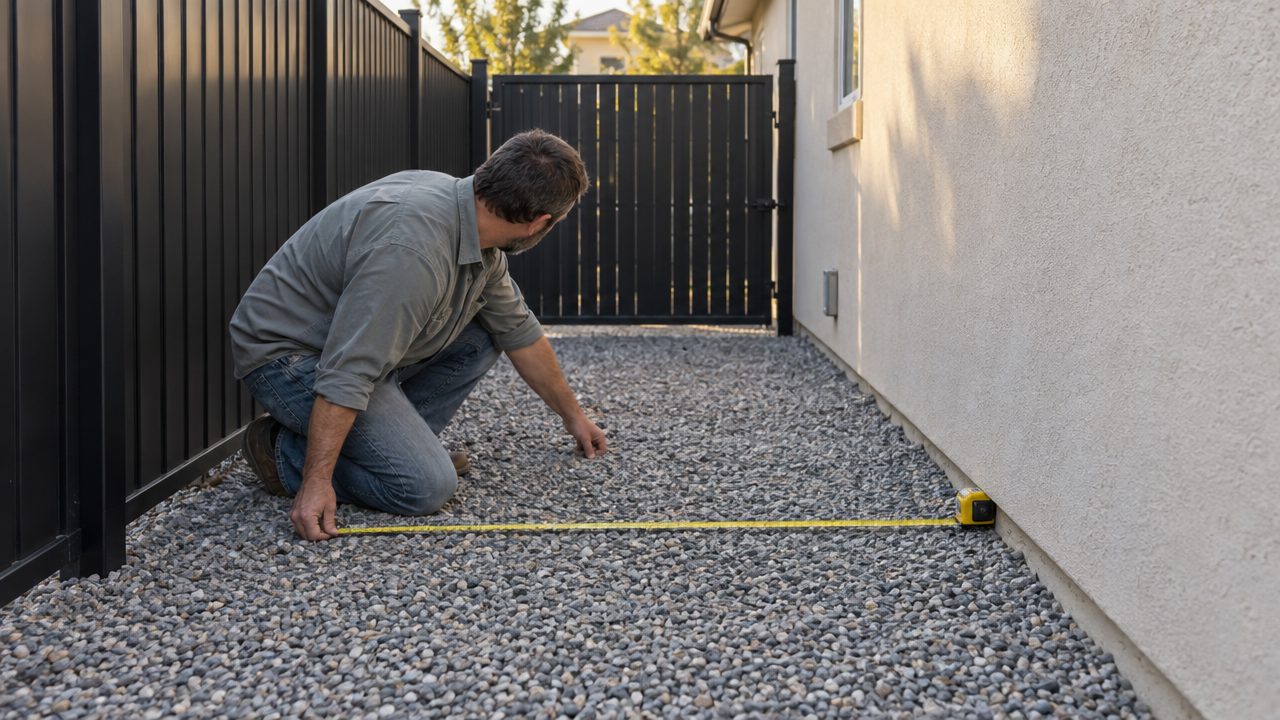
In practice it means a noncombustible panel or gate at each point where a fence meets the house. The Board’s September 2026 guidance says: “Replace the first 5 feet of attached fences with metal or non-combustible materials.”
The span runs 5 feet from the point of attachment, and a side gate is often only 3 or 4 feet wide. Our reading, which the rule and guidance do not spell out: a wood gate post or filler panel at the wall sits inside those 5 feet, so it would need to be noncombustible too, along with enough fence beyond the gate to reach 5 feet. Your local inspector makes the final call.
The Board’s July 2026 staff memo says the purpose “is not to require wholesale replacement of existing wood fences” and that “Fences more than five feet from the structure are not impacted by the draft regulation.” For the step-by-step work, see how to comply with Zone Zero.
Does a fence that stops short of the wall still count?
Yes, if it ends within 1 foot of the house. Section 1298.04(b)(9)(A) covers fences that “come within one (1) foot of contact” with the structure. Leaving a 6 inch gap between the last wood post and the siding does not take a fence out of the rule. The 5 feet is then measured from “the point closest to the Occupied Structure.”
A wood fence that already ends more than 1 foot from the house falls outside that paragraph. It is still inside Zone 0, though, so it cannot be rebuilt in wood: a new fence there would hit the ban in (b)(9)(B). Local rules can be stricter (see San Diego below).
Do I have to replace my whole wood fence?
No. Existing combustible fences may stay, and the rule expressly allows repairs with wood. The September 2026 guidance says Zone 0 standards apply “only where an attaching combustible gate exists, or a fence is fully replaced,” and only within Zone 0; the July 2026 memo uses the same words.
If you tear out and replace an entire fence that runs within 5 feet of the house, the new section inside Zone 0 has to be noncombustible, because it is a new fence. And while wood repairs are allowed, the attached 5 feet still has to meet the noncombustible span by your deadline, so a wood patch there will need replacing later anyway.
What about a fence that runs parallel to the house?
New combustible fences parallel to the house within 5 feet are banned once the rule is effective (1298.04(b)(9)(B)). The rule text does not order an existing parallel wood fence out. The guidance, which is advice rather than rule text, asks owners to “work to upgrade the fence to a noncombustible material along this section,” and adds: “This does not mean replacing the entire fence, but only the section that is within five feet of the structure.”
The Board’s guidance notes that some insurers require the IBHS Wildfire Prepared Home designation. That program’s 2026 checklist goes further than the rule: “Replace wood or vinyl fencing within 5 feet of the home with noncombustible fencing (e.g. metal).”
How is Zone 0 measured?
Zone 0 starts at “the exterior surface of the exterior wall, roof, attached deck, stairs, or pergola” and extends 5 feet out or to the property line, whichever comes first (1298.04(a); 1299.03(a)(i)). Two details matter for fences:
- An attached deck, stair or pergola counts as part of the house, and so does a self-supporting one within 1 foot of it (1298.02(h)). A fence that meets your deck is a fence attached to the structure.
- The rule lists the roof among the surfaces Zone 0 is measured from, but the guidance says Zone 0 “starts at the face of the exterior wall” and tells owners of other house shapes to “understand where the roof dripline comes down.” Ask your inspector where they measure from under deep eaves.
What counts as noncombustible for a Zone 0 fence?
The rule defines noncombustible as “Materials that pass the American Society for Testing and Materials (ASTM) E136 test, thus meeting the standard for ‘noncombustible materials’ described in Section 501.4.1” of the California Wildland-Urban Interface Code (1298.02(f); 1299.02(g)). An exception in Section 501.4.1 also accepts a noncombustible base with a surfacing no thicker than 0.125 inch and a flame spread index of 50 or less under ASTM E84. In our reading, that is the clause a powder-coated metal fence would rely on.
Steel and aluminum. The Board’s guidance says to use metal. Fire Safe Marin names steel and fiber cement for fences and “ready-made steel and aluminum products” for gates. Aluminum raises a fair question, since the Aluminum Association says aluminum melts at around 660 C (1220 F). Its fire-safety paper reports that all the alloys it had tested to ASTM E136 in 2011 and 2020, including 6063, “met the required criteria for passing the test.” It attributes the exclusion of materials that melt to a different standard, ASTM E2652. For any metal fence, ask the seller for a product-specific E136 report and, for a coated product, an E84 flame-spread result for the coating.
Vinyl. Fire Safe Marin calls vinyl “also a combustible material,” and UC ANR says vinyl fences “would likely melt during fire conditions.” IBHS groups wood and vinyl together as fencing to replace near the home.
Hog wire. Fire Safe Marin says “it is not recommended to use hogwire as a gate connecting to a structure.”
The rule sets up no approval or listing program for fence products, so a “Zone 0 approved” label on a product page does not refer to any state approval.
How are local rules like San Diego’s different?
AB 1455 (Chapter 731, Statutes of 2025) lets a local agency adopt the state requirements with alternatives that have “substantially similar practical effects,” or adopt stricter ones. San Diego already applies its own rules in its Very High zones. Its Zone 0 Guidelines (Rev. 4/22/2026) applied Zone 0 to new structures on 28 February 2026 and phase existing structures in from 28 February 2027, with a target of full compliance, including “replacing fences and gates that do not comply,” by 28 February 2029.
San Diego’s fence section is stricter. It requires “a minimum 5-foot non-combustible transitional span” where an attached fence runs out from the house, and it prohibits parallel combustible fencing in Zone 0 that creates a continuous fuel pathway. Under an approved compliance plan, all existing fences and gates within 5 feet must be noncombustible, with narrow exceptions for existing vinyl and for new fire-retardant-treated wood listed in the State Fire Marshal’s WUI Products Handbook, both only where the fence runs parallel to the house at least 4 feet away. Where a city or county has its own ordinance, its inspector enforces that version.
When will fences have to comply?
Nothing is due until the state rule takes effect. From the effective date:
| Who | Fence deadline | Rule section |
|---|---|---|
| New homes (permit application filed after the effective date) | Immediately | 1298.04(c)(1); 1299.03(e)(1) |
| Existing homes, LRA Very High zones | 3 years, or up to 5 years on a timeline set by the local fire agency | 1298.04(c)(4) |
| Existing homes, SRA | 5 years, or a CAL FIRE Director timeline of no less than 3 years | 1299.03(e)(4) |
| Any home building a new fence | No new combustible fence within 5 ft from the effective date | 1298.04(b)(9)(B); 1299.03(d)(9) |
The Board’s guidance says the attached gate or panel is due “within five years of the Zone 0 regulation adoption.” The rule text governs, and in the LRA it says 3 years unless the local agency sets a longer timeline.
What does a compliant house-end section cost?
One San Diego contractor, JJ’s Fence Company, publishes $2,000 to $2,500 for a 5 to 10 foot aluminum Zone 0 section without a gate, and from $3,000 with a gate (undated page, checked 10 November 2026). That is one firm’s published pricing. Our Zone Zero cost guide has the full range and its basis.
The work can count with your insurer now. The California FAIR Plan’s discount list includes a property with “only noncombustible materials incorporated into any improvements to the property, including fences and gates, within 5 feet of the dwelling.” More on that in our Zone Zero insurance discount guide.
What we don’t know yet
- The effective date. The package was withdrawn on 8 September 2026 and was not on OAL’s under-review list on 10 November 2026.
- The final text. If the Board revises the rule before resubmitting, the fence wording or deadlines could change. We will update this page against the text OAL approves.
- How inspectors treat edge cases, such as a few inches of wood left inside the 5 feet, or a fence that meets a neighbor’s house on the property line.
- SRA enforcement timing. Under Public Resources Code 4291 as amended, CAL FIRE cannot change its inspection practices or enforcement for Zone 0 until the State Fire Marshal posts a written finding that the Legislature has funded it.
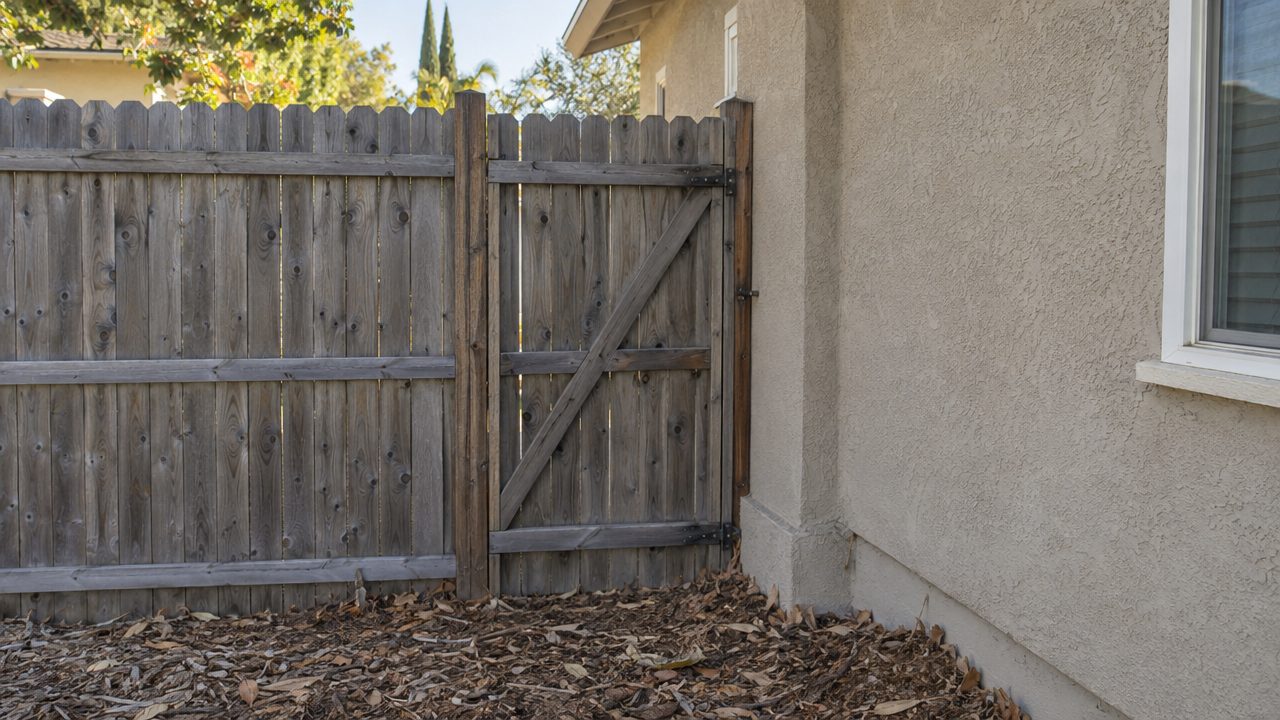 Before: wood at the wall
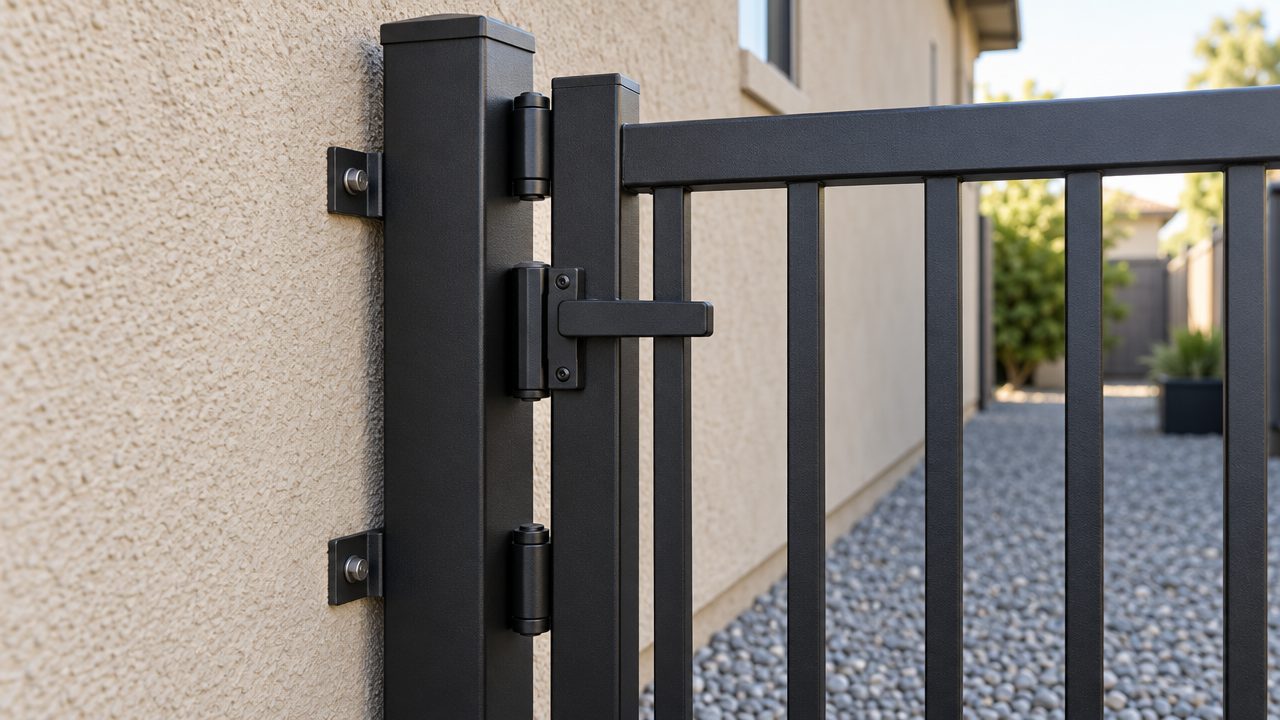 After: metal for the first 5 ft
Questions people ask
What happens to a wood fence attached to my house under Zone 0?
Under the rule the Board adopted on 19 August 2026, which is not in effect as of 10 November 2026, the first 5 feet of an attached fence or gate, measured from the house, must be noncombustible. The rest of the wood fence can stay and can be repaired with wood. Existing homes would get 3 to 5 years from the rule's effective date to make the change.
What are the Zone 0 requirements for gates?
The rule treats fences and gates together. Under the adopted but not yet effective rule, any gate attached to the house or within 1 foot of it must fall inside a 5 foot noncombustible span measured from the house, and no new combustible gate may be installed within 5 feet of the house.
What counts as a non combustible gate?
The rule defines noncombustible as material that passes the ASTM E136 test, meeting Section 501.4.1 of the California Wildland-Urban Interface Code. Fire Safe Marin points to ready-made steel and aluminum gates. Ask the seller for an E136 report covering the product's material.
Is vinyl fence fire resistant enough for Zone 0?
Not for the section at the house. Fire Safe Marin calls vinyl a combustible material, UC ANR says vinyl fences would likely melt in a fire, and the IBHS Wildfire Prepared Home checklist says to replace vinyl fencing within 5 feet of the home. A vinyl section attached to the house would not give the 5 foot noncombustible span in the adopted state rule.
Keep reading
 GuideZone Zero in California: the law, who it covers, deadlines
 GuideHow to comply with Zone Zero in California
 GuideZone Zero compliance cost: what homeowners may pay
 GuideZone Zero insurance discount: what California insurers give
More in Fences and gates
Sources
- Board of Forestry, Zone 0 regulation summary and rule text as approved (14 CCR 1298 et seq., 1299 et seq.), .
- Board of Forestry staff clarification memo on Zone 0 (July 23, 2026 workshop), .
- Board of Forestry, Zone Zero Guidance Document (dated September 2026, adopted 19 August 2026), .
- OAL, Emergency Regulations Under Review (no Board of Forestry entry when checked), .
- OAL, Recent Actions Taken on Emergency Regulations (file 2026-0828-03E, withdrawn 8 September 2026), .
- CA Defensible Space, Zone 0 rule status (filing and withdrawal dates, quoting OAL's record), .
- AB 1455 (Bryan), Chapter 731, Statutes of 2025, .
- California Wildland-Urban Interface Code 2025, Chapter 5 (Section 501.4), .
- Aluminum Association, Fire Safety of Aluminum and Its Alloys (undated; accessed), .
- San Diego Fire-Rescue, Zone 0 Guidelines for Existing Structures (Rev. 4/22/2026), .
- Fire Safe Marin, Fences, .
- UC ANR Fire Network, Fence, .
- IBHS Wildfire Prepared Home 2026 checklist, .
- California FAIR Plan, discounts for Dwelling Fire and Commercial policies, .
- JJ's Fence Company, partial fence replacement for Zone 0 (published pricing, undated), .
Spot an error? Tell us and we will correct it and note the change.