In this article (16)
Is Zone 0 compliance required yet?
No statewide requirement is in force. The Board voted 8 to 0 to adopt the regulation on August 19, 2026, filed it with the Office of Administrative Law (OAL) on August 28 as file 2026-0828-03E, and withdrew it on September 8 before OAL ruled. OAL’s list of emergency regulations under review showed no Board of Forestry entry on November 10, 2026.
The Mountain Democrat reported on October 28, 2026 that Marcie Thompson, a Board program manager, expected the package back at the Board’s November 5 meeting for approval of changes, with the soonest effective date “at the very end of November, maybe early December.” That report is unconfirmed: we could not check the Board’s own site, and as of November 10 we had seen no record of the package being resubmitted. For the full status history, see Zone Zero California law.
Selling a house does not trigger the rule: that version depended on SB 326, vetoed on October 11, 2025 (veto sustained March 2, 2026). Some cities already enforce their own Zone 0 rules; San Diego is covered below.
Does Zone 0 apply to my home?
The state rule covers two areas only:
- Every building in the State Responsibility Area (SRA), under Public Resources Code 4291. The rule text for these homes is 14 CCR 1299.03.
- Occupied structures in a Very High Fire Hazard Severity Zone in the Local Responsibility Area (LRA), meaning land a city or county protects, under Government Code 51182. The rule text is 14 CCR 1298.04.
High and Moderate zones in the LRA are outside the state rule, although a local ordinance can reach them.
How do you measure the 5-foot zone?
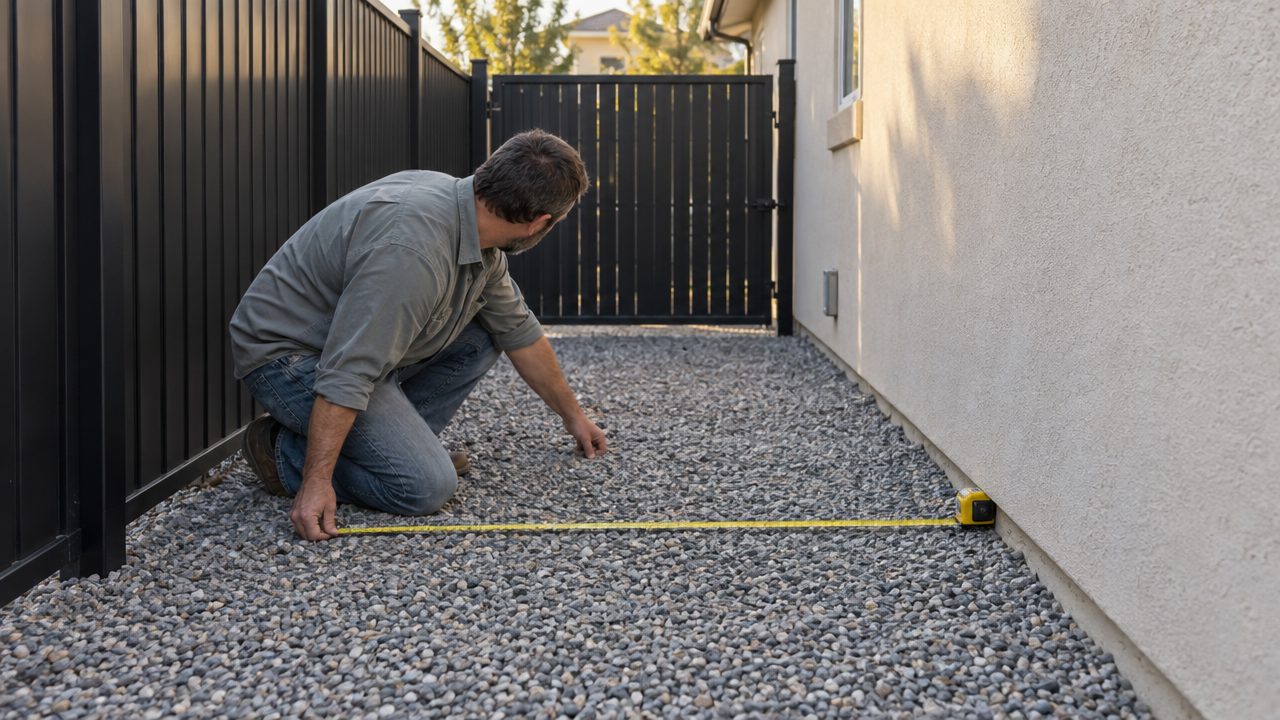
Zone 0 starts at the outside face of the exterior wall, the roof edge, and any attached deck, stairs or pergola, and runs 5 feet out or to your property line, whichever comes first (1298.04(a); 1299.03(a)). The Board’s guidance has diagrams for cantilevered second stories.
A few measuring rules catch people out:
- A deck, stair or pergola that stands on its own posts but sits within 1 foot of the house counts as attached, so the 5 feet are measured from its outer edge (1298.02(h)).
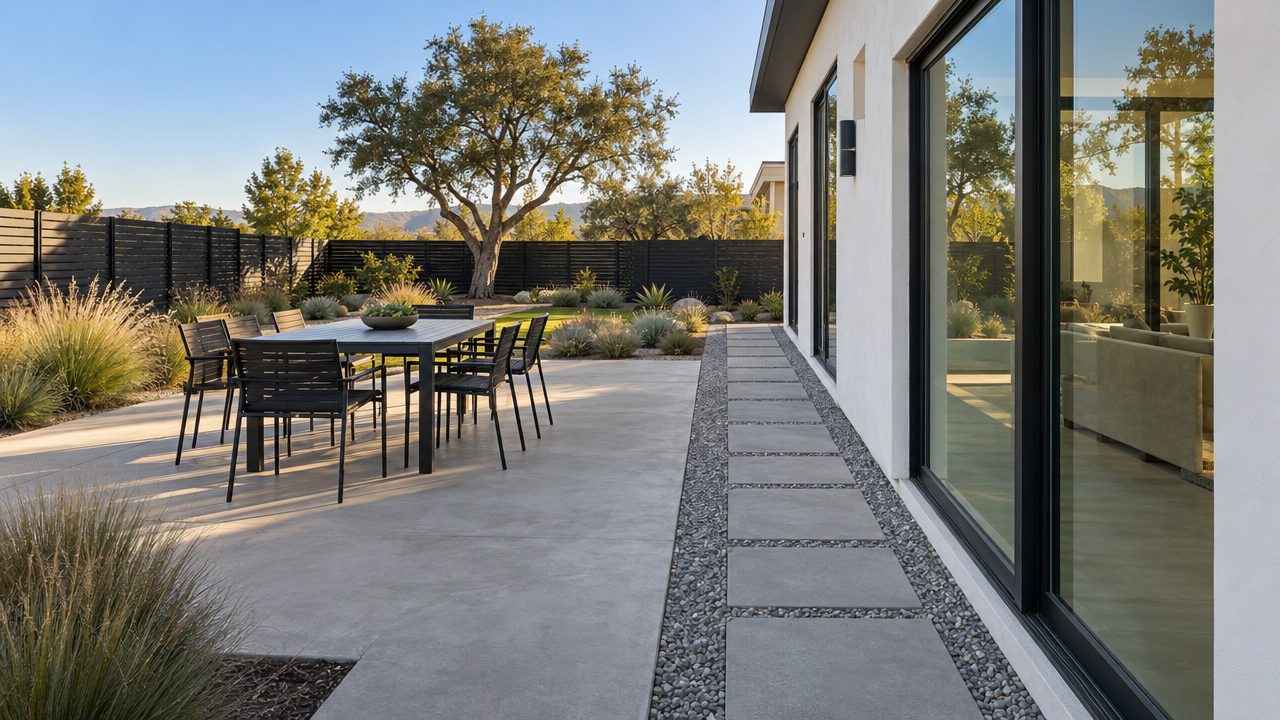
- A patio made of noncombustible material does not extend the zone (1298.02(h); 1299.02(a)).
- If a neighbor builds a new house or ADU near your line, that does not create new Zone 0 obligations on your lot (1298.04(a); 1299.03(c)).
What has to happen as soon as the rule takes effect?
For existing homes, three items apply on the effective date (1298.04(c)(2); 1299.03(e)(2)):
- Keep the roof and rain gutters clear of leaves, needles and other debris.
- Remove dead or dying branches from trees in the zone.
- Keep live branches at least 10 feet from chimneys and stovepipe outlets, and out from under the eaves.
Firewood is a split case. In the rule text, the Zone 0 firewood ban ((b)(4)) is a three-year item. The Board’s September 2026 guidance says existing regulations “still require the immediate removal of exposed firewood piles,” and the current SRA rule already tells owners to relocate exposed piles unless covered in fire-resistant material (14 CCR 1299.03). So an uncovered woodpile against the house should go now.
What is due within three years?
Existing homes get three years from the effective date for the next group (1298.04(c)(3); 1299.03(e)(3)):
- Combustible material. Nothing combustible within the full 5 feet: fallen leaves and needles, bark, wood chips and other combustible mulch, and debris (1298.04(b)(1)). The guidance counts shredded-rubber mulch as fuel too. Inspectors may allow temporary mulch exceptions to control erosion during construction or emergencies.
- Under decks and stairs. The space under decks, balconies, pergolas and stairs must be free of vegetation and stored items (b)(3).
- Firewood. None stored in Zone 0 (b)(4).
- Ladder fuels. Remove branches in the lowest 6 feet of a tree, or the lowest third of its height if that is less, plus fuels within 5 feet above the roof that create a high risk of fire transmission (b)(5)(D).
- Roof and wall clearance. Live branches at least 5 feet above the roof and at least 1 foot from the walls (b)(5)(E). The LRA text limits the wall clearance to walls with no eave; the SRA text does not.
For a mulch replacement, the guidance says weed cloth under rock mulch is allowed, and suggests compacted decomposed granite, sand, pavers or natural stone as alternatives.
Which plants can stay in Zone 0?
Existing trees can stay if they are maintained to the clearances above. The Board’s August 2026 summary of the rule says no new trees can be planted in Zone 0 from the effective date, to align with the California Wildland-Urban Interface Code. The rule text itself (1298.04, 1299.03) sets only tree maintenance standards.
Other plants are limited by where they sit. No vegetation is allowed (b)(6):
- under eaves, or within 1 foot of the wall where there is no eave (this strip is at least 1 foot wide and extends to the edge of the eave, up to 5 feet);
- within 2 feet of windows, doors, posts or vents (the SRA text lists windows, doors and vents);
- within 5 feet of an attached deck, stairs or pergola.
In the rest of the zone you may keep (b)(7):
- well-maintained non-woody plants under 3 inches tall, including lawn and ground covers;
- non-woody plants 3 to 18 inches tall in clumps no bigger than 1 square foot, spaced 1.5 times the height of the tallest plant;
- non-woody plants up to 18 inches tall in unattached noncombustible pots of 5 gallons or less, with the same spacing.
What does Zone 0 require for fences and gates?
Three rules apply in both the LRA and SRA texts:
- A combustible fence or gate may not be attached to the house (1298.04(b)(8); 1299.03(d)(8)).
- Any fence or gate attached to the house, or within 1 foot of it, needs a 5-foot noncombustible span measured from the attachment point (b)(9)(A).
- After the effective date, no new combustible fence or gate may be built within 5 feet of the house (1298.04(b)(9)(B); 1299.03(d)(9)). The LRA text adds that this applies whether the fence is attached or parallel to the house.
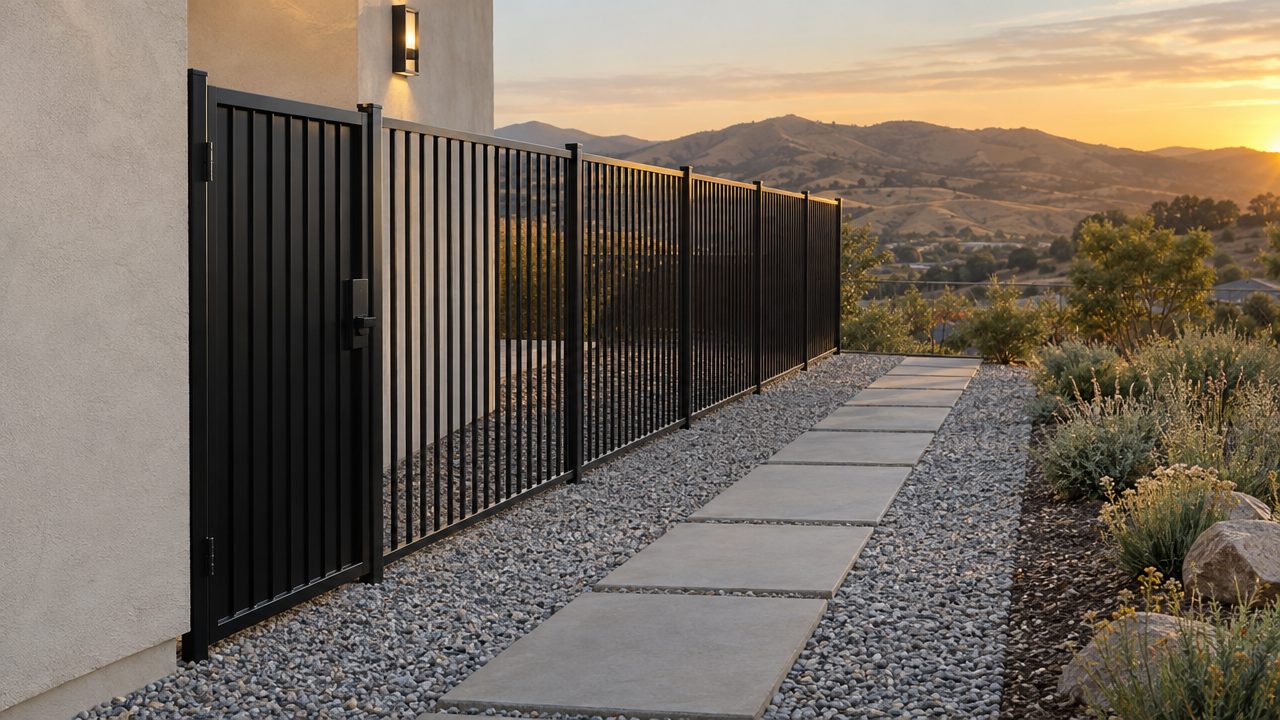
Existing wood fences beyond the 5-foot span can stay and can be repaired with wood (b)(9)(C). The Board’s guidance says the rule “does not require wholesale replacement” of wood fences and that fences more than 5 feet from the house are not affected. For a typical side-yard fence, the work is the gate or the first 5-foot panel where it meets the house; the guidance tells owners to prioritize that section. The rule defines noncombustible as passing ASTM E136 (1298.02(f); 1299.02(g)). Details, materials and the aluminum question are in Zone 0 fence requirements.
What about decks, sheds and other structures?
The rule sets no material standard for decks. It measures the zone from the deck’s outer edge, requires the area underneath to stay clear, and bars vegetation within 5 feet of it. The guidance recommends, as best practice, metal mesh screening around the deck perimeter to keep debris and embers out from underneath.
Outbuildings under 120 square feet, such as small sheds, are not allowed in Zone 0 unless they are built entirely of noncombustible materials (1298.04(b)(10); definition at 1298.02(i)). Either move a wood shed more than 5 feet from the house or replace it.
What is the compliance timeline for existing homes?
Every clock starts on the effective date, which has not been set. New homes, meaning a building permit application submitted after that date, must meet everything on day one.
| Requirement | LRA (14 CCR 1298.04(c)) | SRA (14 CCR 1299.03(e)) |
|---|---|---|
| Roof and gutters clear; dead branches; chimney and eave clearance | Effective date | Effective date |
| Combustible mulch and debris; under decks; firewood; ladder fuels; roof and wall clearance | 3 years | 3 years |
| Vegetation buffers, plant limits, fences and gates, outbuildings | 3 years, or up to 5 years on a local agency timeline | 5 years, or a CAL FIRE Director timeline of not less than 3 years |
The Board’s guidance says attached fences and gates are due “within five years,” but for city and county Very High zones the rule text sets 3 years unless the local fire agency allows up to 5. Plan on the rule text.
Who checks, and what happens if you are not finished?
Local fire agencies enforce in the LRA through their own inspection programs. In the SRA, the Board’s guidance says CAL FIRE inspectors will help owners “prioritize actions over three years,” confirm “good-faith progress,” and favor education and technical assistance. The Board’s summary describes the five-year rollout as education first, with “measurable progress” as the goal.
There is also a funding condition. Under Public Resources Code 4291(h), CAL FIRE cannot change its defensible space inspection practices, forms or enforcement for the ember-resistant zone until the State Fire Marshal makes a written finding, posted on CAL FIRE’s website, that the Legislature has appropriated sufficient resources. We had not seen that finding reported as of November 10, 2026.
Can your city’s rules be different?
Yes. AB 1455 (2025) lets a local fire agency adopt the requirements by ordinance, adopt alternatives with “substantially similar practical effects,” or go further. The rule (1298.03) requires local alternatives to be approved by the city council, board of supervisors or other governing body. Under AB 1455, an owner who complies with alternative practices adopted in a local ordinance is not deemed in violation of the state requirements.
San Diego already runs a local rule. Its Fire-Rescue Zone 0 Guidelines (Rev. 4/22/2026) applied Zone 0 to new structures on February 28, 2026 and phase existing homes in from February 28, 2027, with full compliance, including fences and gates, by February 28, 2029. San Diego also prohibits parallel combustible fencing in Zone 0 that creates a continuous fuel pathway, with narrow exceptions for some vinyl and fire-retardant-treated wood. Check your own city or fire district before you plan the work.
In what order should you do the work?
This order follows the rule’s deadlines:
- Confirm you are in the SRA or an LRA Very High zone, and check for a local Zone 0 ordinance.
- Walk the house with a tape and mark 5 feet from the walls, roof edge, and any attached deck, stairs or pergola.
- Clean the roof and gutters, cut dead branches, and clear branches from the chimney and eaves.
- Move the woodpile, and anything stored under decks and stairs.
- Pull combustible mulch and replace it with rock, decomposed granite or pavers.
- Limb up trees and cut branches back from the roof and walls.
- Clear the strip under the eaves, around windows, doors and vents, and around attached decks. The guidance suggests starting at the decks.
- Replace the 5 feet of wood fence or the wood gate where it meets the house. Cost ranges are in Zone Zero compliance cost.
- Move or replace a wood shed that sits in the zone.
- Photograph the finished work. The Board’s guidance says sharing photos and information about your fuel management may make a home more attractive to insurers; see Zone Zero insurance discounts.
What we don’t know yet
- The effective date. Nothing runs until OAL approves the rule and it is filed with the Secretary of State.
- Whether the Board changed the text when it took the package back. The Mountain Democrat’s October 28 report quoted Board staff describing edits; that is unconfirmed and we have not seen a revised text.
- How each local agency will set its LRA timeline between 3 and 5 years, and when CAL FIRE’s funding condition for SRA enforcement will be met.
Questions people ask
What is on a Zone 0 checklist?
Under the rule the Board of Forestry adopted on August 19, 2026: no combustible mulch, leaves or debris within 5 feet of the house; clean roof and gutters; nothing stored under decks or stairs; no firewood; trees trimmed (no dead branches, 10 feet from chimneys, 5 feet above the roof, none under eaves); a vegetation-free strip under the eaves and near windows, doors and vents; low, spaced non-woody plants only in the rest of the zone; no combustible fence or gate attached to the house; and no combustible shed in the zone. The rule was not in effect as of November 10, 2026.
Can I replace a wood gate with a metal gate and keep the rest of my wood fence?
Yes. Once it takes effect, the rule the Board adopted in August 2026 (14 CCR 1298.04(b)(9) and 1299.03(d)(9)) asks for a 5-foot noncombustible span where a fence or gate meets the house; it was not in effect as of November 10, 2026. The Board's September 2026 guidance says wood fences beyond that span can stay and can be repaired with wood. Replacing a wooden gate with a noncombustible metal one is the example the Board's August 2026 rule summary gives.
What happens at a Zone Zero inspection?
The Board's September 2026 guidance says CAL FIRE inspectors in the State Responsibility Area will help owners prioritize actions over three years and look for good-faith progress, with education ahead of penalties. In cities and counties, local fire agencies run the inspections and set their own approach. No state Zone 0 inspection can enforce the rule until it takes effect.
How do I make a wood fence fire resistant enough for Zone 0?
For the 5-foot span where a fence meets the house, the state rule adopted in August 2026 (not in effect as of November 10, 2026) asks for noncombustible material, defined as material that passes the ASTM E136 test, so plan on metal, masonry or another product with an E136 result. San Diego's local guidelines treat fire-retardant-treated wood as a narrow exception for some parallel fences, separate from noncombustible. Existing wood fence beyond the span can stay and be repaired with wood.
Keep reading
 GuideZone 0 fence requirements in California
 GuideZone Zero in California: the law, who it covers, deadlines
 GuideZone Zero compliance cost: what homeowners may pay
 GuideZone Zero insurance discount: what California insurers give
More in How-to
Sources
- Board of Forestry, Zone 0 regulation summary and rule text (14 CCR 1298.04, 1299.03), as approved, .
- Board of Forestry, 2026 Guidance for Creating and Maintaining Defensible Space (Zone Zero guidance document), .
- OAL, Emergency Regulations Under Review (no Board of Forestry entry), .
- AB 1455 (Bryan), Chapter 731, Statutes of 2025, .
- SB 504 (Dodd), Chapter 982, Statutes of 2024, .
- AB 3074 (Friedman), Chapter 259, Statutes of 2020, .
- SB 326 (Becker) bill history, veto sustained, .
- City of San Diego Fire-Rescue, Zone 0 Guidelines for Existing Structures, Rev. 4/22/2026, .
- Mountain Democrat, Zone 0 wildfire defense plan coming to high fire hazard areas, .
Spot an error? Tell us and we will correct it and note the change.