
In this article (11)
To install an aluminum fence gate, set two heavy-wall gate posts in concrete at the spacing your gate maker specifies, let the concrete cure, then hang the gate on two aligned hinges and fit the latch on the opposite post. Gate post holes run 18 to 35 inches deep on fences up to 6 feet, and the concrete should set at least 24 hours before you hang the gate.
Gate makers disagree most on the first measurement you take, so read your own gate’s instructions alongside this page. Swapping out a wood gate at the house? How to replace a wood gate with a metal gate covers removal and the Zone 0 measurements; this page goes deeper on the install.
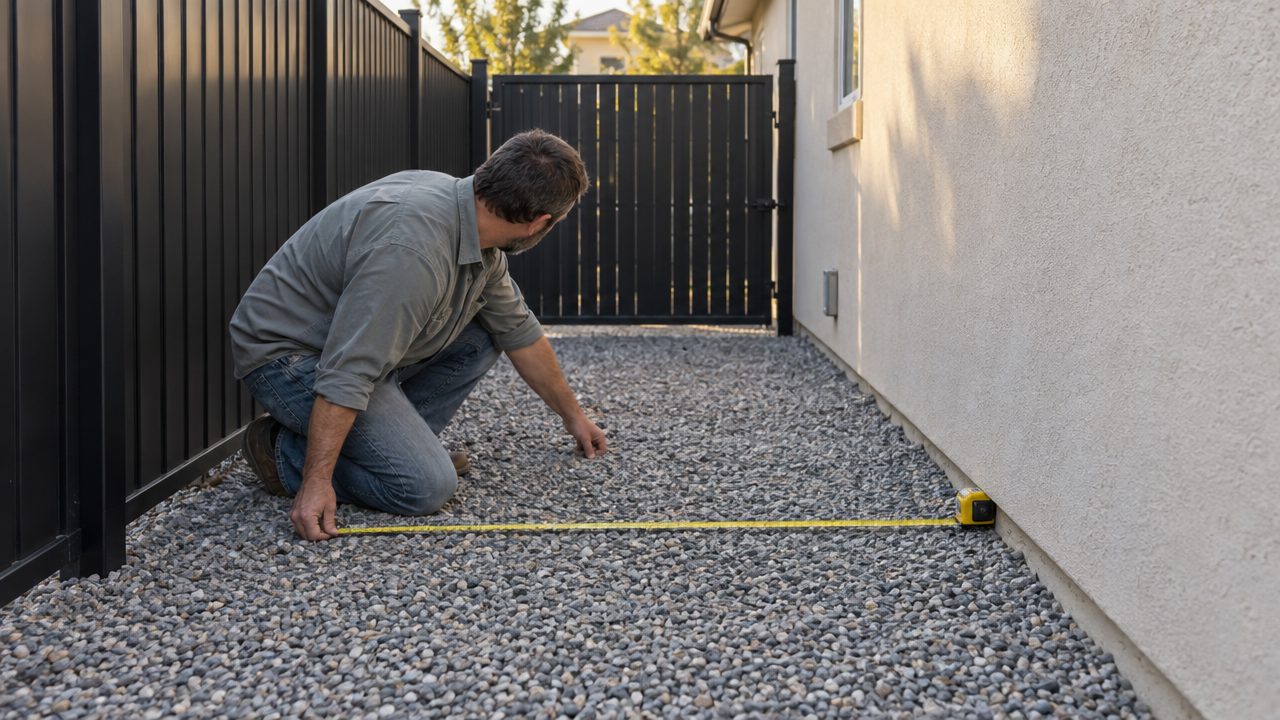
How far apart should aluminum gate posts be?
That depends on how your gate is sold. Gates are sized three ways:
| Sizing convention | What “48 inch gate” means | Post spacing (inside to inside) |
|---|---|---|
| Sized to the opening | Made to fit a 48 inch opening, with about 3/4 inch left at each post, so the frame is roughly 46-1/2 inches | 48 inches |
| Sized to the frame | The gate itself measures 48 inches | 49 to 49-1/2 inches (1 to 1-1/2 inches wider than the gate) |
| Gate plus hardware | Frame width; add clearance for hinges, latch and any drop rod | Frame plus the hardware clearances (about 1 inch for heavy drive gate hinges) |
Say you want a 42 inch side gate. For a gate sized to the opening, the posts go 42 inches apart. If the frame itself measures 42 inches, the posts go 43 to 43-1/2 inches apart. Mixing the two up puts you off by an inch or more, enough for a gate that binds or a gap the hinges and latch cannot span.
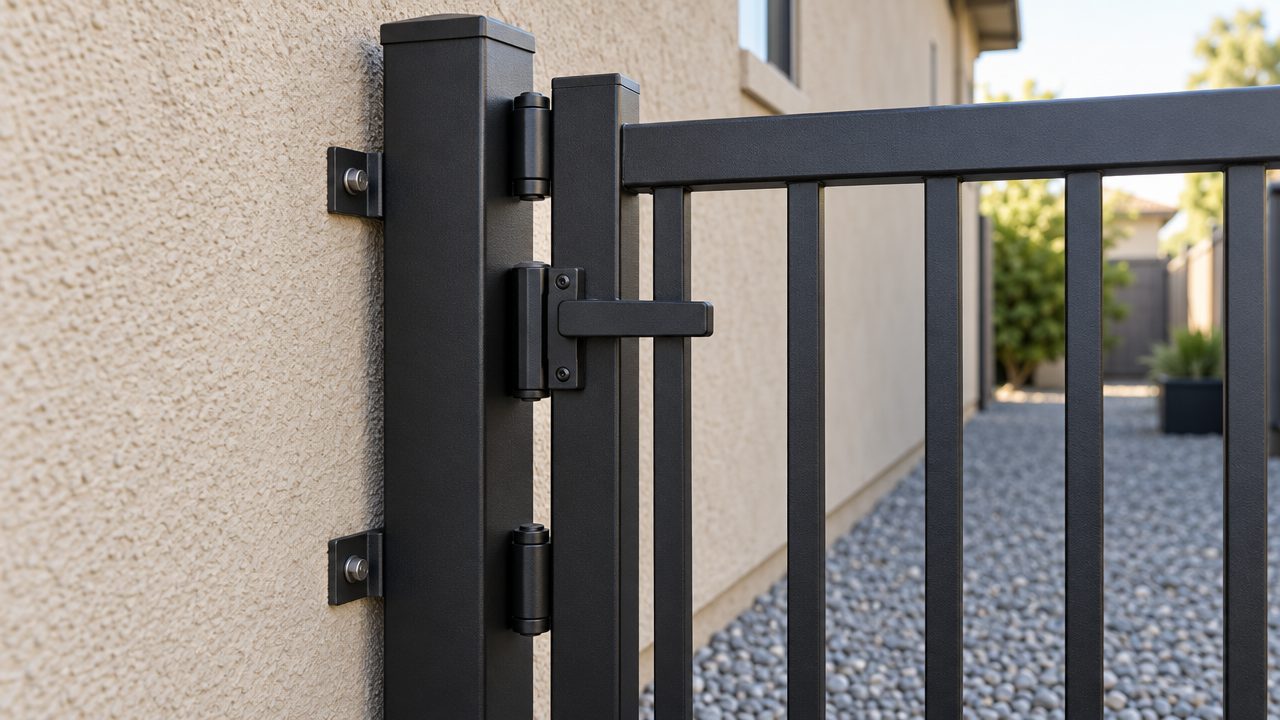
So check the hinge before you pour concrete. D&D’s Mini-Multi Adjust hinge needs at least 3/4 inch between post and gate, with a maximum of 1-1/4 to 2 inches depending on model. Its Heavy Duty Multi-Adjust works across 16 to 43 mm (about 5/8 to 1-11/16 inches).
How deep do gate posts go?
Use your fence maker’s chart, deeper if local code or the frost line requires it. Two typical charts:
| Fence height | Minimum post depth, chart A | Hole depth, chart B (post in ground) |
|---|---|---|
| 36 in | 18 in | 27 in (21 in) |
| 42 in | 24 in | 27 in (21 in) |
| 48 in | 18 in | 27 in (21 in) |
| 54 in | 24 in | 33 in (27 in) |
| 60 in | 18 in | 33 in (27 in) |
| 72 in | 24 in | 35 in (29 in) |
Chart B puts about 6 inches of pea stone in the bottom of a hole roughly 6 inches wide, which is why the hole is deeper than the post. Plan on a hole at least 6 inches across and about 40 to 60 pounds of concrete per hole, and stop the concrete about 2 inches below ground.
Use the posts sold as gate posts. A gate post matches the end post in size, but its walls are about twice as heavy to carry the weight and latching of a gate, and the gate only works properly if those posts go in correctly.
How long should concrete set before hanging the gate?
At least 24 hours. Hang the gate only after the concrete has set. Done yourself, that makes it a two-day job, posts first and gate the next day. A professional gate job runs four to eight hours, so ask an installer how they handle the wait.
Before you dig, call 811. Government Code 4216.2(b) requires excavators to give at least two working days’ notice; a homeowner doing permit-free work at home is exempt under 4216.8, but a contractor you hire is not.
How do I install aluminum fence gate hinges?
- Decide the swing. On common spring hinges, the springs go on top for a gate hinged on the left that opens toward you, or hinged on the right that opens away, and on the bottom for the other two cases.
- Mount hinges to the gate first, on a flat surface. Put the bottom hinge about 6 inches from the bottom of the gate upright and the top hinge about 6 inches from the top, with 3/32 inch pilot holes. Space self-closing hinges as far apart as possible and pre-drill metal gates with a 5/32 inch bit for D&D hinges.
- Block the gate at height. Set the gate on two 2 inch spacer blocks; most aluminum gates hang about 2 to 3 inches above the ground. Install on level ground.
- Fix the hinges to the post. Mark through the hinge holes, take the gate away to drill, then refit and screw home. On D&D’s Heavy Duty hinge, the vertical-adjustment side of both hinges goes on the post.
- Check alignment. If the hinges are not in line with each other, the gate will not close by itself.
For a steel gate or any heavy one, get the gate’s weight from the seller and compare it with the hinge rating. D&D rates the Mini-Multi Adjust for gates up to 55 lb (a 5 by 3 foot gate) and the Heavy Duty Multi-Adjust for gates up to 154 lb.
How do I adjust the self-closing tension?
Adjust in small steps, about a quarter turn at a time, and keep equal tension on both hinge springs. Turning some hinges more than a quarter turn switches self-closing off. Never take a spring hinge off the gate until the spring tension is released.
Where does the latch go, and how high?
On the opposite post. Mount the latch, close the gate, align the strike, center it in the latch and fasten it. Use a gate stop or a latch with a striker so the gate cannot swing through the fence line.
If the gate is part of a pool enclosure, California sets the height: gates must “open away from the swimming pool,” be self-closing, and have “a self-latching device placed no lower than 60 inches above the ground” (Health and Safety Code 115923(a)). The same section caps the gap under the enclosure at 2 inches (115923(c)), so a pool gate cannot hang at 3 inches. D&D’s Heavy Duty hinges need at least 45 inches between hinges on a US pool gate. For other gates, follow the latch maker’s instructions.
Why does my aluminum gate sag or not latch?
Check the post first. Fit post caps before pouring so the posts are not knocked out of alignment while the concrete is wet, because a hinge post out of plumb throws off everything hung on it. Then check that the hinges line up and carry equal tension; either fault leaves a gate that will not close by itself. If the latch side has dropped, D&D’s Heavy Duty hinge adjusts about 1/2 inch up or down.
Does the gate need anything special for Zone 0?
Only if the gate is attached to the house or comes within 1 foot of it. Then the gate and its posts have to be noncombustible, because California’s Zone 0 rule requires a 5 foot noncombustible span from that point (14 CCR 1298.04(b)(9)(A)). A metal gate on metal posts, with metal fence out to the 5 foot mark, is what it asks for. For a post fixed to stucco or block, see attach a gate to a house wall. Aluminum carries one open question: the lab test the rule uses says it is not suitable for materials that melt (is aluminum noncombustible?). Steel is not affected.
When should I hire out the install?
Hire a fence contractor if the hinge post mounts to the house wall, if the ground slopes across the opening, or if the gate is heavier than your hinges are rated for. Kit and installed prices are on metal gate cost, and choosing the gate is covered in the aluminum side gate buying guide. The rest of the 5 foot zone is in how to comply with Zone Zero.
Questions people ask
How do you install aluminum fence gate hinges?
Lay the gate on blocks so it sits level at its finished height, place one hinge near the top rail and one near the bottom rail, drill pilot holes and screw the hinges to the gate, then to the post. The two hinges must line up, or a self-closing gate will not close by itself. Check the hinge's gap range first: D&D's Mini-Multi Adjust hinge needs at least 3/4 inch between post and gate.
Keep reading


More in How-to
Spot an error? Tell us and we will correct it and note the change.