
In this article (10)
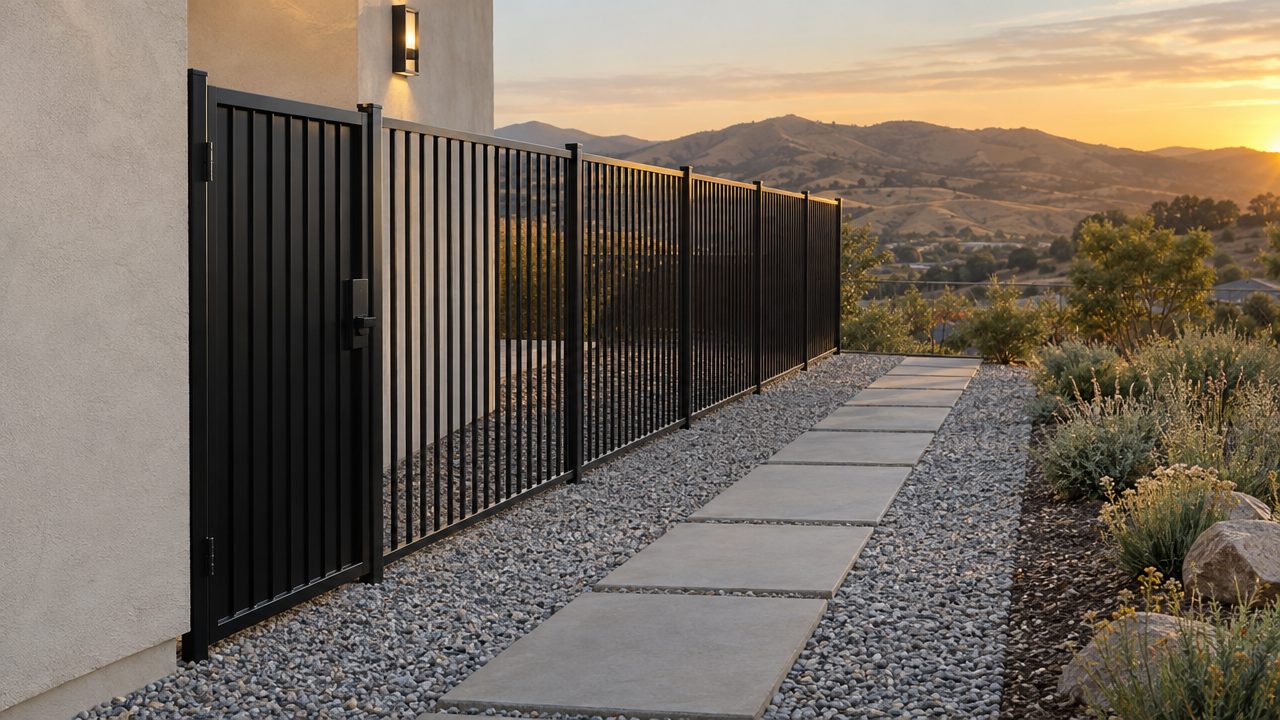
Three side gates next to the house, and whether each covers the 5 foot span.
See the rule detailsA good aluminum side gate is a 3 or 4 foot walk gate on metal posts, with a latch and hinges rated for its weight. Prices run from about $397 for a picket gate with no hardware to $843 for a 4 by 6 foot privacy kit with hinges and latch, posts extra.
If the gate meets the house wall in a mapped California fire zone, buy it with metal posts and plan for the full 5 feet. California’s Zone 0 rule requires a 5 foot noncombustible span from the point where a fence or gate meets the house (14 CCR 1298.04(b)(9)(A)), and the posts at that point are part of it, so a gate bought now should meet it. The rest of this page is about choosing the gate. For the rule itself, see Zone 0 gate requirements, and for installed prices see metal gate cost.
How wide should a side gate be?
Walk gates are typically 3 or 4 feet wide. The width you order depends on the opening and on the posts you set in it. Gates are sized to the clear opening between posts (a 48 inch gate fits a 48 inch opening), with about 3/4 inch left between the gate and each post.
Measure the side yard at the top, middle and bottom, take the smallest number, and subtract both posts. An opening of 47 inches with two 2 inch posts leaves 43 inches of clear opening to size the gate to. Check what has to pass through: a wheelbarrow barely fits through a 36 inch gate, so 4 feet is the safer width.
For Zone 0, width matters in a second way. A gate narrower than 60 inches leaves part of the 5 foot span to posts or a short metal panel. The gate requirements page has a table of what is left over for 36, 42 and 48 inch gates.
Privacy boards or pickets?
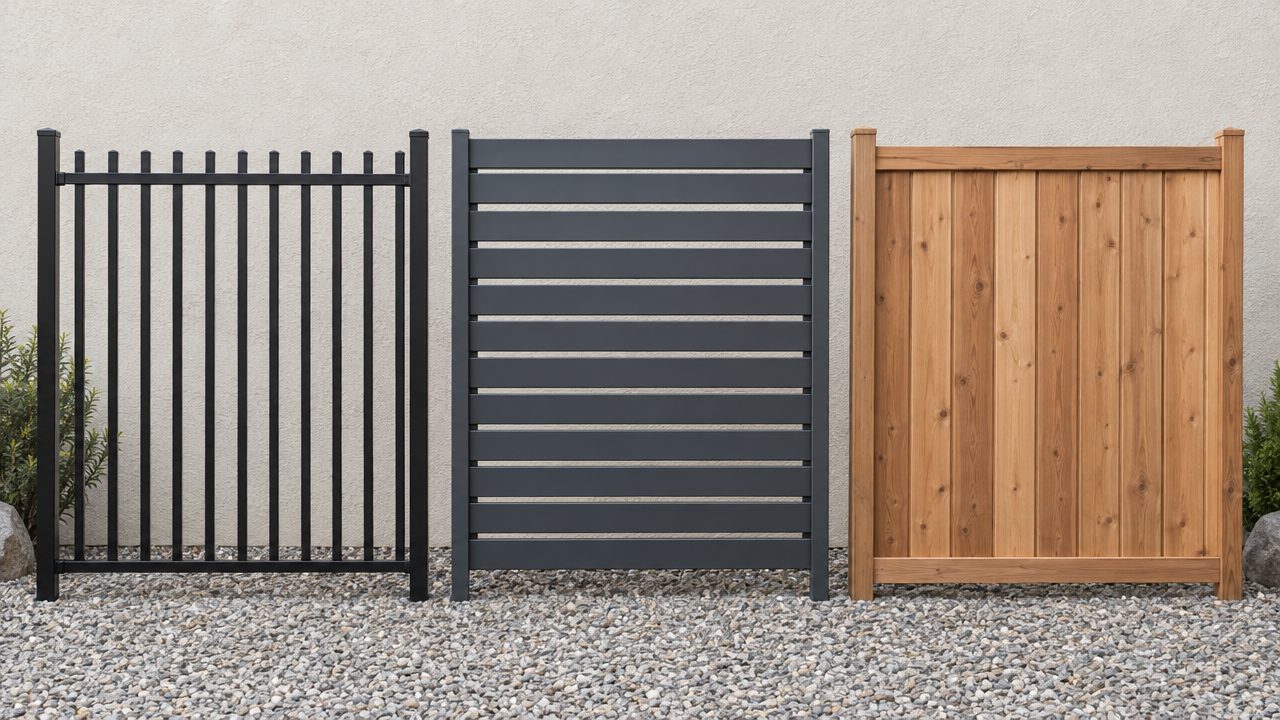
The two main styles:
- Privacy (horizontal boards). Horizontal woodgrain-finish boards with a 3/8 or 1/2 inch gap, tongue-and-groove boards with no gap, or a solid panel for full privacy.
- Picket. A typical arched walk gate has 5/8 inch square pickets spaced 3-13/16 inches apart, in heights of 3 to 6 feet.
If the side gate is also part of a pool enclosure, see the pool section below before choosing horizontal boards.
Kit, prehung or custom?
A kit ships flat and you assemble it. The better kits bolt together with no welding, using ordinary tools, and some makers offer custom sizes. A welded gate arrives in one piece but in fixed widths such as 3, 4, 5 or 6 feet.
Read the listing for what is aluminum. A frame kit that you fill with your own wood boards is a wood gate once it is built. Inside the 5 feet at a house, the Zone 0 rule names wood as combustible.
Ground posts or a wall-mounted post?
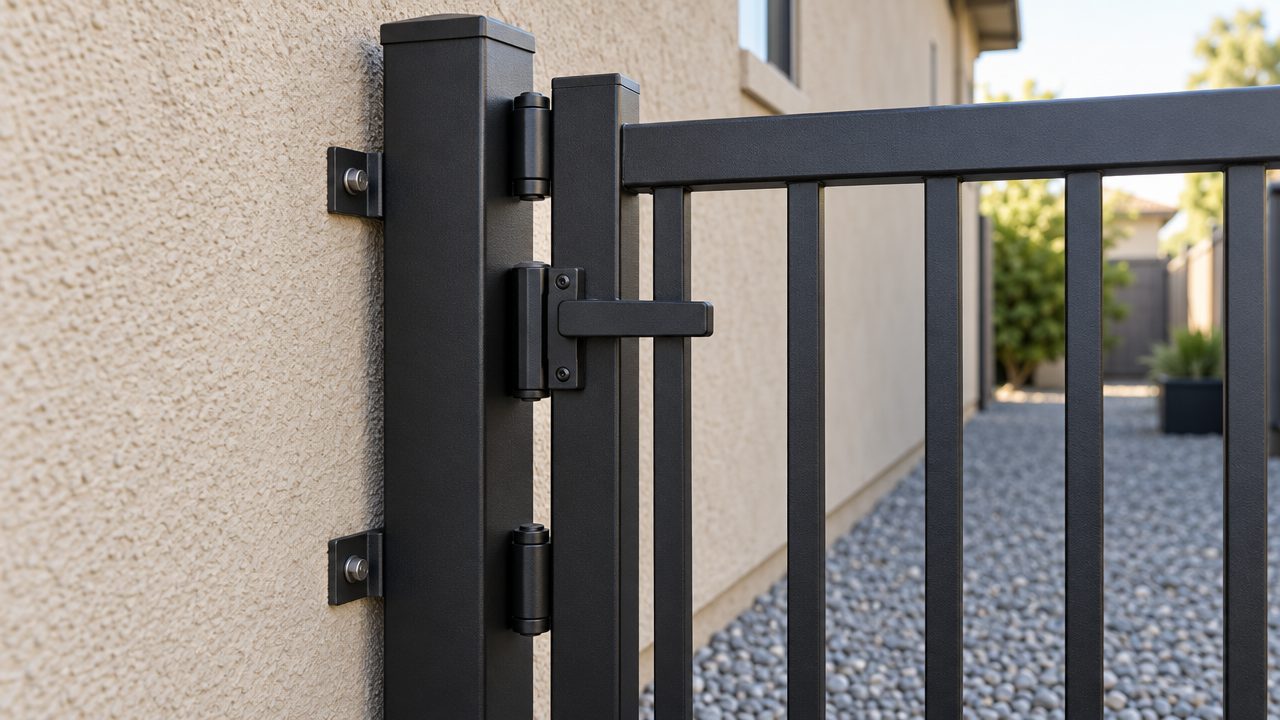
Most side gates hang between two posts set in concrete. Where the gate starts at the house, one post can be a wall-mounted post fastened flat to the framing or masonry, so no post hole is needed at the wall. The attaching a gate to a house wall page covers stucco, block and siding.
Post size follows the gate. Light picket gates hang on 2 inch square posts, sold separately, and 4 inch posts are the norm for gates over 24 square feet. An 8 foot, 3 by 3 inch aluminum post lists at about $147. Budget for two unless one is a wall post.
Which hinges and latch?
Self-closing hinges pull the gate shut after you walk through. D&D’s TruClose heavy duty hinge for metal gates is rated for up to 154 pounds per pair on a gate up to 6 feet high by 4 feet wide, and lists at about $54 to $60 per pair, with screws sold separately.
Latches. D&D’s MagnaLatch Top Pull Series 3 is a magnetic, lockable latch at about $73 to $89. The top-pull design raises the release knob out of children’s reach.
In a fire zone, check what the hardware is made of. Both of those products have polymer bodies: the hinge is glass-fiber reinforced polymer and the latch is engineering polymer with stainless parts. The Zone 0 rule says nothing about hardware, so if you want every part of a gate at the house to be metal, ask for metal hinges and latches and check with your fire inspector.
Does a pool change the gate rules?
It can, if the side gate is part of the barrier around a pool. Under California’s Swimming Pool Safety Act, when a building permit is issued for a new or remodeled pool or spa at a single-family home, it needs at least two of seven drowning prevention features (Health and Safety Code 115922). One of those is an enclosure, and Section 115923 spells out what counts, including that access gates “open away from the swimming pool, and are self-closing with a self-latching device placed no lower than 60 inches above the ground.” The same section calls for:
- a minimum height of 60 inches;
- no more than 2 inches between the ground and the bottom;
- no gaps that allow “passage of a sphere equal to or greater than four inches in diameter”;
- an outside surface free of handholds or footholds that would let a child under five climb over.
Many pool codes elsewhere set the latch at 45 inches or higher. For a gate that is part of a California enclosure under 115923, the statute says 60, so mount it there. Your city building department applies the enclosure rules, and some cities amend them, so confirm before you buy a gate with horizontal boards for a pool barrier.
What do aluminum side gates cost?
2026 prices:
| Gate | Size | Price | Hardware included? |
|---|---|---|---|
| Arched picket walk gate | 3 to 6 ft wide, 3 to 6 ft high | $396.59 to $634.51 | No hinges or latch; posts extra |
| Full privacy solid panel gate | 3 or 4 ft wide | About $579 | Varies |
| Tongue-and-groove privacy kit | 4 x 6 ft | $808.75 | Hinges; latch sold separately |
| Woodgrain horizontal board kit | 4 x 6 ft | $843.16 | Hinges, latch, brackets, stainless screws |
Add two posts, concrete and labor. The metal gate cost page builds a full installed price from these parts.
What should you ask the seller?
- Alloy and temper. Most aluminum gates are 6063-T6 or 6063-T5. Get it in writing.
- Coating specification. Good gate finishes meet or exceed AAMA 2604, which limits color loss over 5 years of Florida sun and calls for 3,000 hours of salt spray; AAMA 2605 calls for 4,000. Near the coast, ask whether 2605 is offered.
- An ASTM E136 report, if the gate is going at the house in a fire zone. ASTM E136 is a furnace test at 750 C, and the Zone 0 rule defines noncombustible by it. Lab reports from 2020 found bare blocks of alloys including 6063 met the E136 criteria, but the standard’s own scope says it is not suitable for materials that melt, and aluminum melts at about 660 C. How that applies to aluminum is unsettled, and no regulator has ruled on it; steel is not affected. The test also excludes coated materials, so a powder-coated gate relies on the exception in Section 501.4.1 of the California Wildland-Urban Interface Code: a noncombustible base plus a coating no thicker than 0.125 inch with an ASTM E84 flame spread index of 50 or less. For aluminum, that base step runs back into the same melting question. None of that is a report on a finished gate (is aluminum noncombustible has the detail). A “Zone Zero ready” label with no test behind it is the seller’s own claim. See is powder-coated aluminum noncombustible.
- What is in the box: hinges, latch, posts, fasteners, and whether any part is wood or plastic.
- Gap and post size, so the gate fits the opening you measured.
For comparisons with steel, vinyl and other fence materials, see the best fire resistant fence guide.
Questions people ask
What should I look for in an aluminum side gate?
Start with the opening minus your posts, then pick privacy boards or pickets. Check that hinges and a latch are included or priced, that the hinges are rated for the gate's weight, and ask for the alloy, the coating specification (AAMA 2604 or 2605) and, for a gate at the house in a Zone 0 area, an ASTM E136 report.
What is the best metal side gate for a house?
For most California side yards, a powder-coated aluminum walk gate 3 or 4 feet wide on metal posts. Near the coast, ask whether an AAMA 2605 coating is offered. If the gate meets the house wall in a mapped fire zone, choose an all-metal gate and metal posts so the first 5 feet meets the state's Zone 0 rule. For aluminum, how the rule's ASTM E136 test applies to a metal that melts is unsettled; steel is not affected.
Keep reading


More in Product comparisons
Spot an error? Tell us and we will correct it and note the change.