In this article (13)
For a fence within 5 feet of a California home, steel and aluminum both work: neither burns, and fire-safety groups accept both. As of 10 November 2026 the choice is about trade-offs. Steel melts far hotter and is stronger; aluminum does not rust, which matters in coastal yards, and weighs about a third as much by volume. The state Zone 0 rule was adopted in August 2026 but is not in effect.
This page compares the two metals only. For the full field, including masonry, chain link and the combustible options, see the pillar, best fire resistant fence. We name no brands.
Do steel and aluminum both meet the Zone 0 rule?
Both can. The Board of Forestry’s adopted rule defines Noncombustible as “Materials that pass the American Society for Testing and Materials (ASTM) E136 test,” meeting Section 501.4.1 of the California Wildland-Urban Interface Code (14 CCR 1298.02(f); 1299.02(g)). Once in effect, it would require a 5-foot noncombustible span on any fence or gate attached to the house or within 1 foot of it (1298.04(b)(9)(A); 1299.03(d)(9)).
The rule names no metal, but outside sources back both:
- NIST’s 2022 fence report classes fences “made of noncombustible materials such as stone, brick, or steel” as low fire hazard.
- The Aluminum Association reports that the alloys it had tested to ASTM E136 in 2011 and 2020 all passed. That is the trade group’s summary of alloy tests, and it covers no specific fence.
- The IBHS Wildfire Prepared Home checklist says fences, posts and gates within 5 feet of the home should use “only noncombustible materials such as metal (e.g., aluminum, steel, chain link, iron), concrete, masonry, or stone.”
The rule is not in force. The Board adopted it 8-0 on 19 August 2026, filed it with the Office of Administrative Law on 28 August (file 2026-0828-03E) and withdrew it on 8 September, before OAL ruled; OAL’s review list had no Board of Forestry entry on 10 November 2026.
How do steel and aluminum compare at a glance?
| Steel | Aluminum | |
|---|---|---|
| Burns? | No | No |
| Melting point | About 1,425 to 1,540 C for carbon steel | About 660 C (1220 F) unalloyed |
| Heat conduction | Lower | 3 to 6 times ordinary steel (Aluminum Association) |
| Rust | Can rust if not maintained (Fixr) | Resists corrosion (Fixr) |
| Density | 7,850 kg/m³ | About 2,700 kg/m³ |
| Strength and dents | Stronger, resists dents better (Fixr) | Dents more easily (Fixr) |
| Price per foot, national | $15 to $60 per ft (Fixr, Jan 2025); $15 to $45 (Fixr, Aug 2025) | $15 to $40 per ft (Fixr, Jan 2025); $13 to $75 (Fixr, Aug 2025) |
Which metal handles wildfire heat better?
Steel has the higher ceiling. Engineering ToolBox lists carbon steel melting at 1,425 to 1,540 C and stainless at about 1,510 C. USGS says wildfires can reach 2,200 F (about 1,200 C) in extreme conditions, which is below steel’s melting range and well above aluminum’s 660 C. Set side by side, those figures mean an aluminum fence can melt in the hottest conditions while steel stays below its melting point.
Melting does not turn a fence into fuel. The Aluminum Association cites fires in which aluminum parts “had melted in the extreme temperatures but did not combust or otherwise contribute to the fires.” It also argues aluminum heats more slowly than you would expect: its specific heat is about twice steel’s, and a bare surface reflects 80 to 90 percent of radiant heat. A painted or powder coated fence does not have a bare surface. The numbers and fire durations are in does aluminum melt in a wildfire.
If your steel is galvanized, Engineering ToolBox puts zinc’s melting point at about 420 C, below aluminum’s, though the steel itself melts far higher.
Does a metal fence conduct heat into the house?
Aluminum moves heat faster. The Aluminum Association gives aluminum alloys a thermal conductivity of 88 to 251 W/(m·K), “3-6 times higher than normal steel and 10-17 times higher than stainless steel.” The trade group presents that as a benefit, since it pulls heat away from a hot spot.
We found no test that measured heat carried along a metal fence into a house wall, for either metal, so we cannot say what the difference means at the siding. The rule targets combustible fences, which can carry flame to the wall, and neither metal burns.
Which holds up better near the coast?
Aluminum, on corrosion. Fixr says aluminum fences “resist corrosion, unlike steel and wrought iron fences, which may rust if not properly maintained,” and that steel “can rust and corrode.” The Aluminum Association also lists corrosion resistance among aluminum’s main properties.
Coastal salt is hard on galvanized steel. The American Galvanizers Association (April 2025) reports that in some instances hot-dip galvanized structures within a mile of the coast but more than 250 feet from it “have exhibited rusting within 5-7 years on surfaces directly subjected to the ocean,” while sheltered surfaces lasted much longer. Within 250 feet, it says salt spray needs separate evaluation. The association adds that paint or powder coating over galvanizing, which it calls a duplex system, extends the service life. We found no comparable coastal service-life figure for aluminum fence.
Is the weight difference important?
It matters most at the house. Engineering ToolBox gives steel a density of 7,850 kg/m³ and aluminum about 2,700, so by volume steel is about 2.9 times as heavy. Actual panel weight depends on tube size and wall thickness, so compare spec sheets.
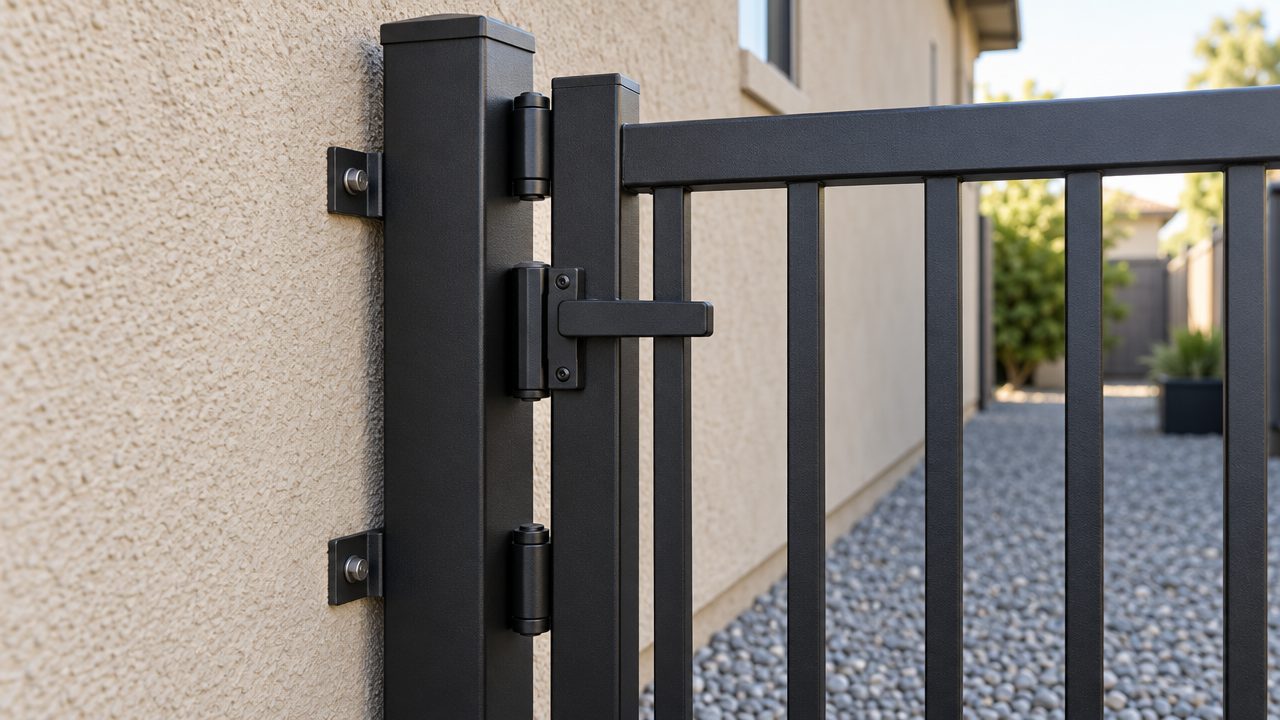
The Zone 0 work usually sits right at the wall: a gate or the first 5-foot panel where the fence meets the house. In our view, a lighter gate also puts less load on a post anchored to the wall or on hinges fastened to it. Fixr says aluminum’s light weight makes it fast and easy to install. Mounting details are in attach a metal gate to a house wall.
Steel’s weight comes with strength. Fixr says “A steel fence is stronger than an aluminum fence and resists dings and dents better,” and that aluminum “may not be the best option for creating a truly secure perimeter fence.”
Which costs more?
The published ranges overlap. Fixr’s national fence-installation table (last updated 31 January 2025) gives $15 to $40 per installed foot for aluminum and $15 to $60 for steel. Its aluminum fence page (29 August 2025) gives $13 to $75 for aluminum and $15 to $45 for steel. Both figures are national averages.
For a Zone 0 job, the per-foot price is a weak guide. JJ’s Fence Company in San Diego County publishes $2,000 to $2,500 for a 5 to 10 foot aluminum Zone 0 section and from $3,000 for a section with a gate. We found no comparable published price for a steel Zone 0 section. More on aluminum pricing is in aluminum fence cost per foot.
How do upkeep and looks compare?
Upkeep favors aluminum. Fixr calls aluminum fences “one of the lowest maintenance fencing materials” and says steel “requires regular maintenance, such as painting and sanding to remove rust spots.” Fixr’s installation guide adds that the paint or powder coat on steel, iron or aluminum can fade or chip.
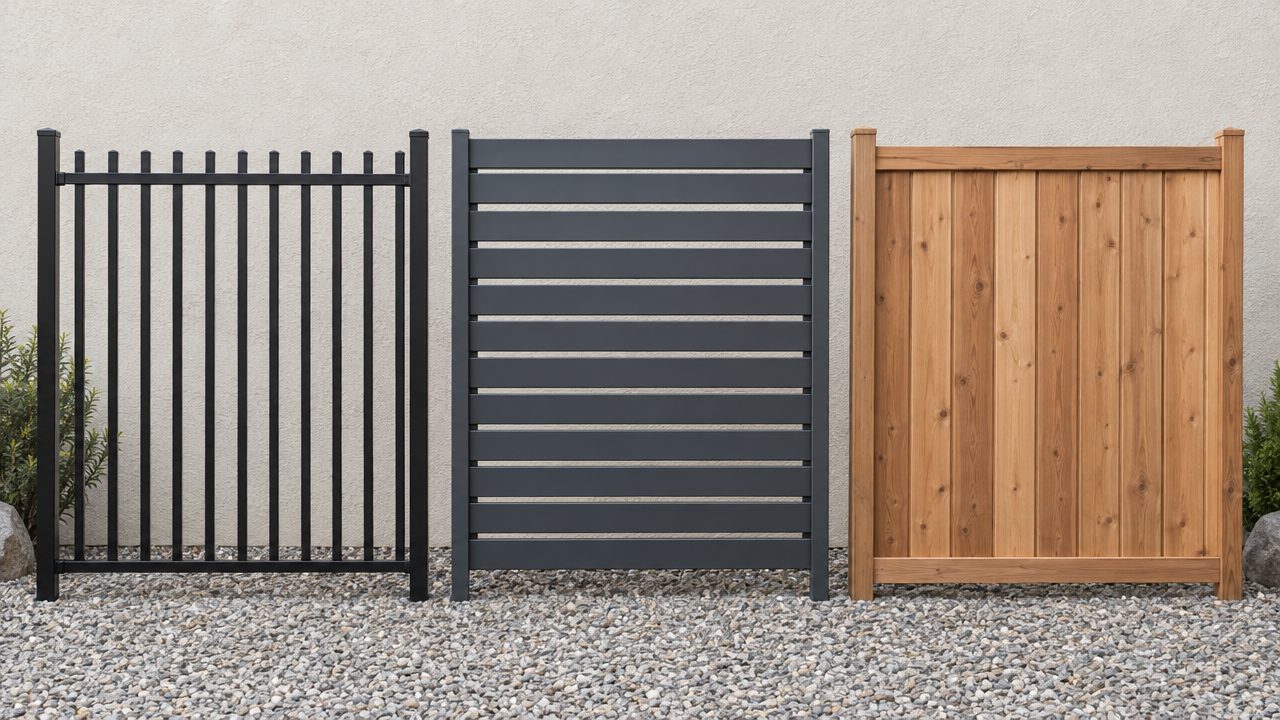
On looks, Fixr says aluminum fences come in “several sizes, colors, and designs,” and Fire Safe Marin says steel fencing comes in “a wide range of styles.” Solid steel has one fire advantage over open designs: UC ANR says solid noncombustible perimeter fences “(such as steel or concrete)” are “effective barriers against radiant energy exposure from fire fronts.”
A painted or powder coated finish on either metal relies on the WUI Code Section 501.4.1 exception for surfacing no thicker than 0.125 inch with an E84 flame spread index of 50 or less; see is powder-coated aluminum noncombustible.
So which should you choose?
- Coastal yard, or you want little upkeep: aluminum.
- Hottest exposure, security, or dent resistance: steel.
- Gate mounted on the house wall: aluminum is lighter on the anchors; steel needs anchors and hinges sized for its weight.
Either way, ask the seller for an ASTM E136 report naming the metal in the product, an E84 result and thickness for the coating, and confirmation that every part in the first 5 feet, posts and filler panels included, is metal.
What we don’t know yet
- When the state rule takes effect, and whether inspectors will ask for E136 paperwork on ordinary steel or aluminum.
- How the two metals compare in a full-scale fire test of a fence attached to a house. We found none.
Questions people ask
Is steel noncombustible?
Yes. Solid steel does not burn. NIST's 2022 fence report lists steel with stone and brick as noncombustible fence materials, and the IBHS Wildfire Prepared Home checklist accepts metal fencing within 5 feet of a home. California's adopted Zone 0 rule, not in effect as of 10 November 2026, defines noncombustible as passing ASTM E136, so ask the seller for that report on the product.
What temperature does aluminum melt at?
Unalloyed aluminum melts at about 660 C (1220 F), according to the Aluminum Association, which adds that most alloys start to lose strength above about 150 C (300 F). Carbon steel melts at roughly 1,425 to 1,540 C (about 2,600 to 2,800 F), per Engineering ToolBox.
Is powder coating flammable?
The Zone 0 rule looks at the coated product as a whole. California's WUI Code Section 501.4.1, which the Zone 0 rule points to, accepts a noncombustible metal with a surface layer no thicker than 0.125 inch and a flame spread index of 50 or less under ASTM E84. Ask for the coating's E84 result and thickness, whether the metal under it is steel or aluminum.
Keep reading
 GuideBest fire resistant fence for Zone 0: materials compared
 Does aluminum melt in a fire? Wildfire and house fire heat
 Is powder coated aluminum noncombustible? The 501.4.1 test
 Aluminum fence cost per foot installed (2026 prices)
- How to attach a gate to a stucco wall
More in Product comparisons
Sources
- Aluminum Association, Fire Safety of Aluminum and Its Alloys (undated; accessed), .
- Engineering ToolBox, Melting temperature of metals (undated; accessed), .
- Engineering ToolBox, Metals and alloys densities (undated; accessed), .
- USGS, How hot are wildfires?, .
- American Galvanizers Association (Brandon Jones), HDG in coastal climates, .
- Fixr (Adam Graham), Aluminum fence cost, .
- Fixr, Fence installation cost (installed cost per linear foot by material), .
- JJ's Fence Company, partial fence replacement for Zone 0 (San Diego County pricing, undated; accessed), .
- Fire Safe Marin, Fences, .
- UC ANR Fire Network, Fence, .
- IBHS Wildfire Prepared Home, How-To Prepare Checklist (undated; accessed), .
- NIST Technical Note 2228-upd1, Wind-Driven Fire Spread to a Structure from Fences and Mulch, .
- California Wildland-Urban Interface Code 2025, Chapter 5 (Section 501.4.1), .
- Board of Forestry, Zone 0 regulation summary and rule text as approved (14 CCR 1298 et seq., 1299 et seq.), .
- OAL, Recent Actions Taken on Emergency Regulations (file 2026-0828-03E, withdrawn 8 September 2026), .
- OAL, Emergency Regulations Under Review (no Board of Forestry entry when checked), .
Spot an error? Tell us and we will correct it and note the change.