
In this article (8)
The first 5 feet of fence from the house must be noncombustible. The rest can stay wood.
See the rule detailsWood fences are a fire hazard to the house they touch or sit near. In 187 fence burns run in 2022 by NIST, the federal National Institute of Standards and Technology, researchers found combustible fences “can be rapid conduits for fire” to attached or nearby structures. The hazard depends on what surrounds the fence: a bare wood fence burned slowly, mulch at its base made it high hazard, and two parallel wood fences were engulfed within minutes.
For a homeowner that comes down to the 5 feet of fence at the house and what lies along its base. Post-fire field work points the same way, though it records what investigators saw rather than measuring risk, and none of it isolates fences as a cause of home losses.
What does this mean for my fence?
Three steps cover most of the risk.
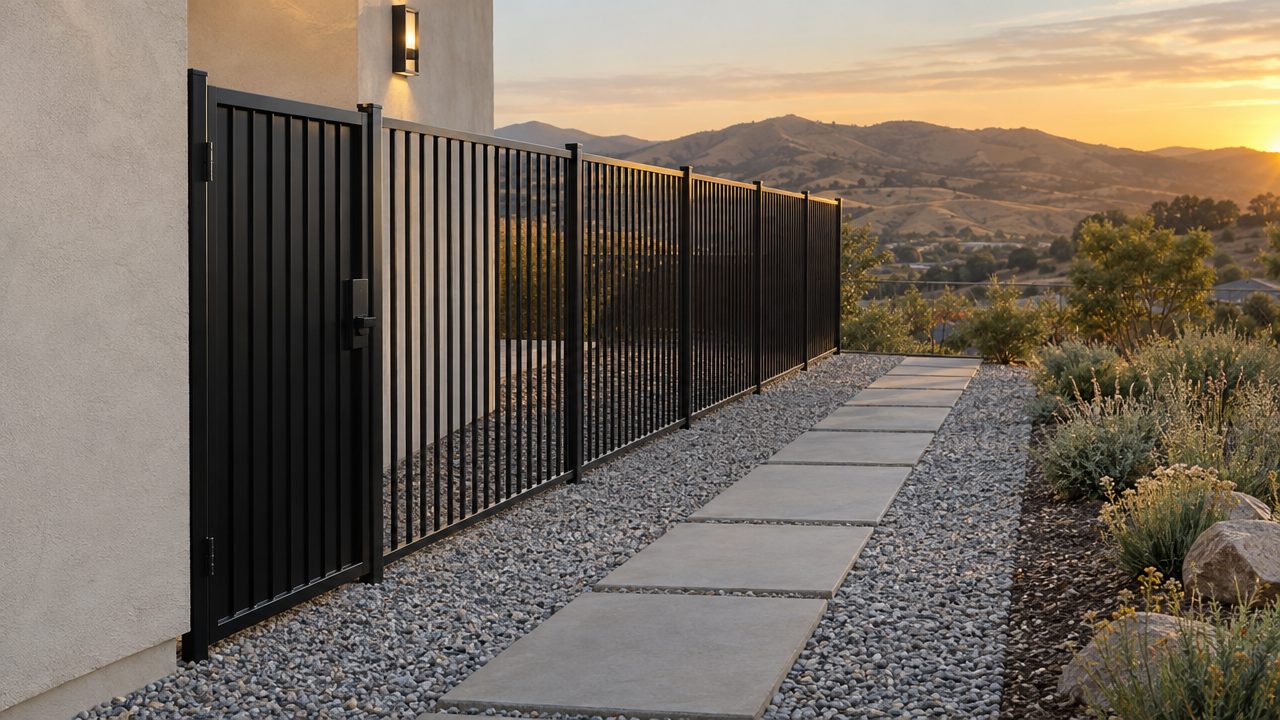
- Make the house end noncombustible. The state Zone 0 rule requires a 5 foot noncombustible span where a fence attaches or comes within 1 foot of the house (14 CCR 1298.04(b)(9)(A); 1299.03(d)(9)). The risk is greatest when a combustible fence, usually wood, attaches directly to the building. See Zone 0 fence requirements and wood fence attached to house.
- Clear the base. Mulch and leaf litter turned a medium-hazard fence into a high-hazard one in NIST’s tests. The Board’s guidance says to “Remove vegetation and combustible materials in contact with the fence.”
- Break up parallel fences. If your fence runs beside a neighbor’s, replace one with a noncombustible fence; the IBHS Wildfire Prepared Home designation asks for this where two combustible fences are less than 5 feet apart.
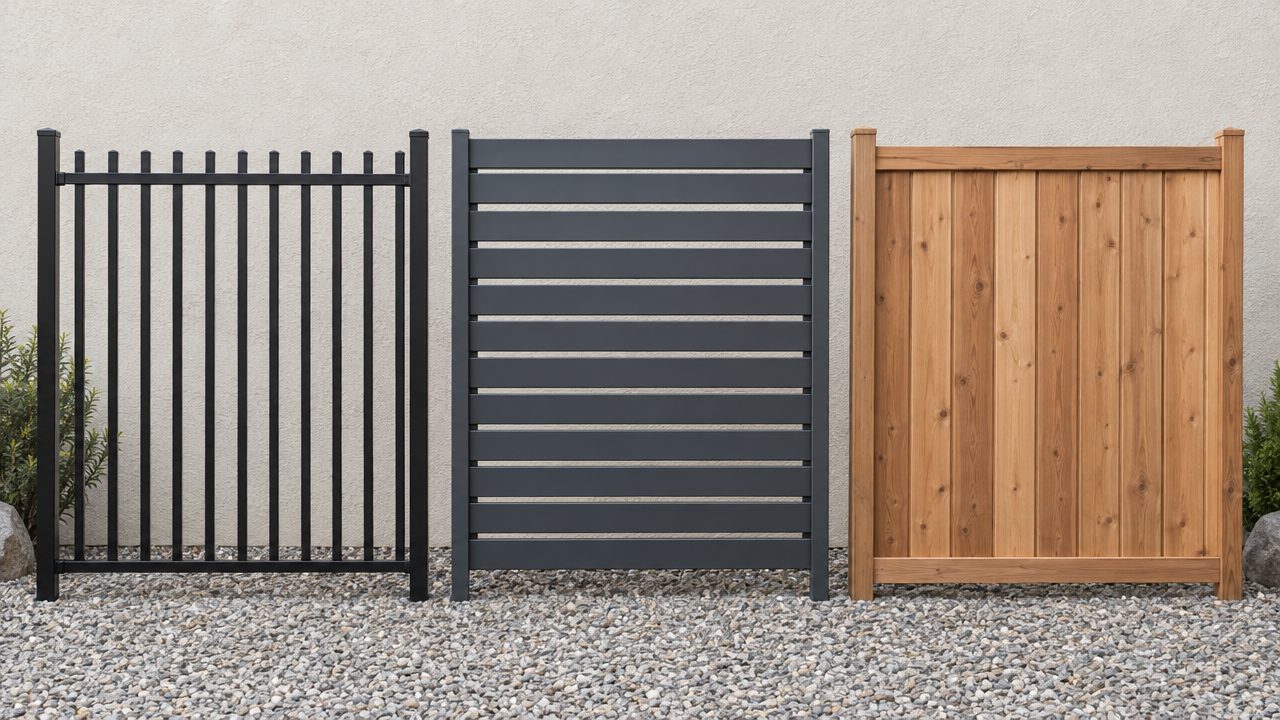
If you are weighing composite boards as the replacement, one of NIST’s two composite fences landed in the very high class (is composite fencing fire resistant).
What did NIST’s fence experiments find?
NIST Technical Note 2228 (Butler, Johnsson and others, August 2022, updated 12 December 2022) ran 187 outdoor burns. Fences of western redcedar, redwood, pine, vinyl and two wood-plastic composites were set perpendicular to a small shed, 0 to 6 feet away, with a wind machine blowing 13 to 31 mph toward it. NIST sorted the results into four hazard classes:
| NIST hazard class | Configurations | What happened |
|---|---|---|
| Very high | Two parallel wood fences; double lattice; one composite fence; good neighbor (board on board) fences | Parallel fences “engulfed in flames within a few minutes,” even 3 ft apart. The composite fence dropped burning boards into a 12 ft wide band of flame. |
| High | Most wood fences with mulch at the base | Fire ran the length of the fence “as a wick.” Every wood fence with mulch lit spot fires in the target bed at the wall. |
| Medium | A single wood fence with no fine fuel around it; vinyl | Slow spread, “dominated by glowing combustion with occasional small flames.” Vinyl with mulch blackened and distorted but threw no firebrands. |
| Low (not tested) | Stone, brick, steel | “They do not burn on their own,” but debris at the base “could potentially allow fire to spread.” |
Flame crossed one wood panel with mulch beneath it in 2 to 5 minutes at medium and high wind, and 7 to 12 minutes at low wind. Firebrands from burning fences and mulch lit spot fires as far as 47.6 m (156 ft) downwind. Shredded hardwood and pine bark mulch kept throwing firebrands for more than an hour.
NIST’s summary finding: “As combustible materials are combined, the hazard increases disproportionately.”
What did the earlier 2016 NIST tests show?
NIST Technical Note 1894 (Johnsson and Maranghides, July 2016) burned cedar, redwood and vinyl privacy fences at wind speeds of 9, 13.5 and 18 m/s. “At all wind speeds tested, a mulch bed was required for flames to spread.” With mulch, fire moved along the fence as fast as 1.44 m (4.7 ft) per minute, fastest when the wind ran in line with the fence. Burning fences caused smoldering ignitions 18 m (59 ft) away.
One result bears on treatments: a wood preservative did not significantly change the spread rate, and cedar and redwood spread at about the same rate. Fire-retardant products are a different category; see fire retardant for a wood fence.
What do post-fire investigations show?
NIST’s 2022 report summarizes its own case studies:
- Tanglewood Complex Fire, Texas (2011). More than 2.4 km (1.5 miles) of fence was damaged or destroyed in a community of 47 residential structures, where 17 homes were destroyed and 4 damaged.
- Witch Creek Fire, California, and Waldo Canyon Fire, Colorado. Investigators observed fire spreading along fences to structures in both. At Waldo Canyon (2012) and other fires, firefighters removed fences to contain the fire.
- Camp Fire, California (8 November 2018). The report prints CAL FIRE photos, taken two minutes apart in Magalia, of fire moving from a wood privacy fence to a structure.
NIST adds that burned wood fences are “often totally consumed, leaving behind only the metal hardware.”
In the January 2025 Los Angeles fires, fire spread rapidly through connective fuels such as privacy hedges and combustible fences, and in Palisades Village most homes were connected to neighbors on at least three of their four sides through vegetation and combustible structures like wood fences. A field survey of 252 structures found that Zone Zero items repeatedly served as connective fuels, and that more than 25% fuel coverage in Zone Zero raised the risk of damage or destruction to nearly 90%. That survey does not break fences out from other fuels.
How does a fence actually reach the house?
NIST names the pathways: direct flame contact, radiant and convective heat, and firebrands (embers). A fence fastened to the wall gives flame a continuous fuel line to the siding. The Board of Forestry’s guidance calls this a fuel ladder and says that upgrading the 5 feet of fence that touches the house “will break the wick of fire.” The California Department of Insurance uses the same image: wood fencing connected to a home “can act like a candle wick leading fire straight to your home.”
A fence that stops short of the house still sends embers. In NIST’s tests, wind around the shed “deposited firebrands next to the structure,” and spot fire timing did not change with distance from 0 to 6 feet. The fence distance page covers what that means for gaps.
What are the limits of this evidence?
NIST lists its own: few experiments were repeated, fuel combinations were limited, ignition came from a propane burner at one spot, and windblown debris was not added in the fence-only burns. Most fence tests used one fence panel (the cedar privacy panels were 8 feet long). After the early burns, the shed wall was noncombustible and a mulch bed at its base was the target, so the results record fire reaching the wall; crews put the fire out before the shed itself could ignite. Noncombustible fences were not tested; their low rating is NIST’s judgment.
The field reports describe what investigators saw. None of them is a statistical survival analysis that isolates fences from other factors such as house spacing, vegetation or construction. Wood type, moisture and design also vary: NIST cites tests by CSIRO, Australia’s national science agency, in which hardwood fences resisted ignition by burning leaf litter while fire crept slowly along treated pine fences until they collapsed.
Questions people ask
Do fences spread wildfire to homes?
Combustible ones can. NIST's 2022 experiments found that combustible fences 'can be rapid conduits for fire and can potentially spread fire to attached or adjacent structures,' and NIST case studies documented fire spreading along fences to structures in the Witch Creek and Waldo Canyon fires. In the January 2025 Los Angeles fires, combustible fences were among the connective fuels that carried fire through neighborhoods.
Keep reading


More in Fences and gates
Spot an error? Tell us and we will correct it and note the change.