
In this article (11)
Concrete is noncombustible, and so are concrete block, brick and natural stone; NIST (the federal National Institute of Standards and Technology) treats them that way too. Stucco counts when it covers masonry rather than wood studs. James Hardie and Allura fiber cement siding has passed ASTM E136, the test California’s Zone 0 rule uses, but those results cover siding, not fence boards.
A block or brick wall at the house end is one of the simplest ways to get the 5 foot noncombustible span the rule requires. What needs checking is what sits on top of the wall, what is inside a “stucco” wall, and the gate.
Is concrete noncombustible under the Zone 0 definition?
The Board of Forestry’s rule names no materials. It defines Noncombustible as “Materials that pass the American Society for Testing and Materials (ASTM) E136 test, thus meeting the standard for ‘noncombustible materials’ described in Section 501.4.1” of the California Wildland-Urban Interface (WUI) Code (14 CCR 1298.02(f); 1299.02(g)). E136 holds a sample in a furnace at 750 C (1382 F); materials that pass are typically classified as noncombustible (ASTM E136-24a, the edition the WUI Code cites).
Concrete and masonry are treated as noncombustible without a product test report:
- The Wildfire Prepared Home standard allows only noncombustible materials within 5 feet of the home, such as metal (aluminum, steel, chain link, iron), concrete, masonry or stone, posts and gates included.
- NIST’s 2022 fence report describes fences “made of noncombustible materials such as stone, brick, or steel” as low fire hazard.
- The WUI Code’s own definition of a noncombustible roof covering lists “Exposed concrete slab roof,” “Cement shingles or sheets” and “Clay or concrete roofing tile.”
An inspector has little reason to ask for a test report on a plain block or poured concrete wall, though the rule sets up no procedure for checking materials. A masonry wall built at the house end now already meets the span the rule requires, as long as nothing combustible is added to it.
Is stucco noncombustible?
The plaster is. Stucco, like brick, fiber cement and masonry veneer, is a noncombustible siding. What decides a stucco garden wall is the core.
- Over block or poured concrete. Every layer is mineral, so it counts.
- Over wood studs. WUI Code 501.4.1’s exception for surfaced materials requires “a structural base of noncombustible material,” and a wood frame is not one. So a wood-framed stucco wall inside the first 5 feet is, in effect, a combustible fence with a cement finish.
If you don’t know which you have, look at the cap, a crack, or where a hose bib or light fixture comes through the wall.
Is fiber cement fireproof?
“Fireproof” is not a code term. The relevant question is whether a product passed E136, and for these three siding products the answer is yes:
| Product | E136 | E84 flame spread / smoke | What it covers |
|---|---|---|---|
| James Hardie | Classified as noncombustible under ASTM E136 | 0 / less than 5, Class A | Hardie Plank, Shingle and Artisan siding |
| Allura | Tested to ASTM E136-16a, classified as noncombustible | 0 / 5 or less, Class A | Allura exterior cladding |
| American Fiber Cement | All products passed ASTM E136 | Most products passed E84 | AFC cladding panels |
Three caveats. These are siding and cladding products; none of the results names a fence board, so ask the maker whether its result applies to the board you would use as fencing. The boards contain wood fiber (cellulose fiber-reinforced cement), so a pass belongs to the tested product, not to fiber cement in general. And fiber cement boards are typically thin, so they need intermediate supports to avoid breakage. Inside 5 feet of the house those supports, posts and rails have to be noncombustible too, which in practice means metal framing.
Do gabion walls and stone count?
A gabion is a steel wire basket filled with rock. Both parts should count as noncombustible, since steel and stone are. Two things change that. Some gabion wire is sold with a PVC coating, which is a plastic surfacing and needs its own E84 result and thickness under 501.4.1, the same check as a powder coat. And a wood cap, bench seat or planter box on top puts wood back inside the span.
Which masonry and cement walls pass for Zone 0?
| Wall | Noncombustible? | Check |
|---|---|---|
| Poured concrete, concrete block | Yes | Wood cap, trellis or lattice on top |
| Brick, natural stone | Yes | Same |
| Stucco over block | Yes | Same |
| Stucco over wood studs | No | The core; treat it as a wood fence |
| Gabion, galvanized wire | Yes | Wood caps or seats |
| Gabion, PVC-coated wire | Depends on the coating | E84 result and thickness for the PVC |
| Fiber cement boards on metal framing | Yes, if the product passed E136 | The product’s E136 report |
| Fiber cement on wood posts | No | The posts |
How much does a masonry wall cost?
Installed ranges, applied to a 10 foot house-end section 6 feet tall (60 square feet):
| Wall | Installed range | 60 sq ft section |
|---|---|---|
| Concrete block | $15 to $20 per sq ft | $900 to $1,200 |
| Block with stucco on one face | Add $6 to $9 per sq ft for stucco | $1,260 to $1,740 |
| Brick fence | $17 to $40 per sq ft | $1,020 to $2,400 |
| Brick privacy wall | $35 to $45 per sq ft, or $200 to $350 per linear ft | $2,000 to $3,500 by the linear-foot figure |
| Natural stone | $40 to $110 per sq ft, materials and labor | $2,400 to $6,600 |
These are national figures, not California quotes, and none includes a gate, permit or engineering. Fiber cement and gabion fencing need local quotes. Metal alternatives are priced on noncombustible privacy fence options.
Do I need a permit for a masonry fence wall?
Often, and at a lower height than for other fences. California Residential Code Section R105.2 exempts “Fences not over 7 feet (2134 mm) high” and retaining walls up to 4 feet from the bottom of the footing, but cities amend it. Los Angeles is the clearest case: its 2026 building codes “require a building permit for masonry or concrete fences over 3 ½ feet high, other fences over 10 feet high” (LADBS Information Bulletin P/BC 2026-080). A permit-free wall up to 6 feet is allowed only as masonry pilasters with no more than 3 feet 6 inches of solid masonry between them and open or lightweight material above.
LADBS’s standard 6 inch block wall detail (P/BC 2020-096) stops at a “6’-0” Height Maximum” and calls for two inspections, so anything taller is outside the standard detail. Zoning height limits apply either way. LA’s wider Zone 0 picture is on Los Angeles Zone Zero.
How should a masonry wall meet the house?
For the rule, the joint is easy. A fence attached to the house or within 1 foot of it “shall have a five (5) foot Noncombustible span from the point of attachment or the point closest to the Occupied Structure” (1298.04(b)(9)(A)). A block wall is noncombustible along its whole length, so the span is met as long as nothing combustible is added inside it: no wood gate, wood cap or lattice extension in the first 5 feet. From the day the rule takes effect, no new combustible fence or gate may go in within 5 feet at all (1298.04(b)(9)(B); 1299.03(d)(9)).
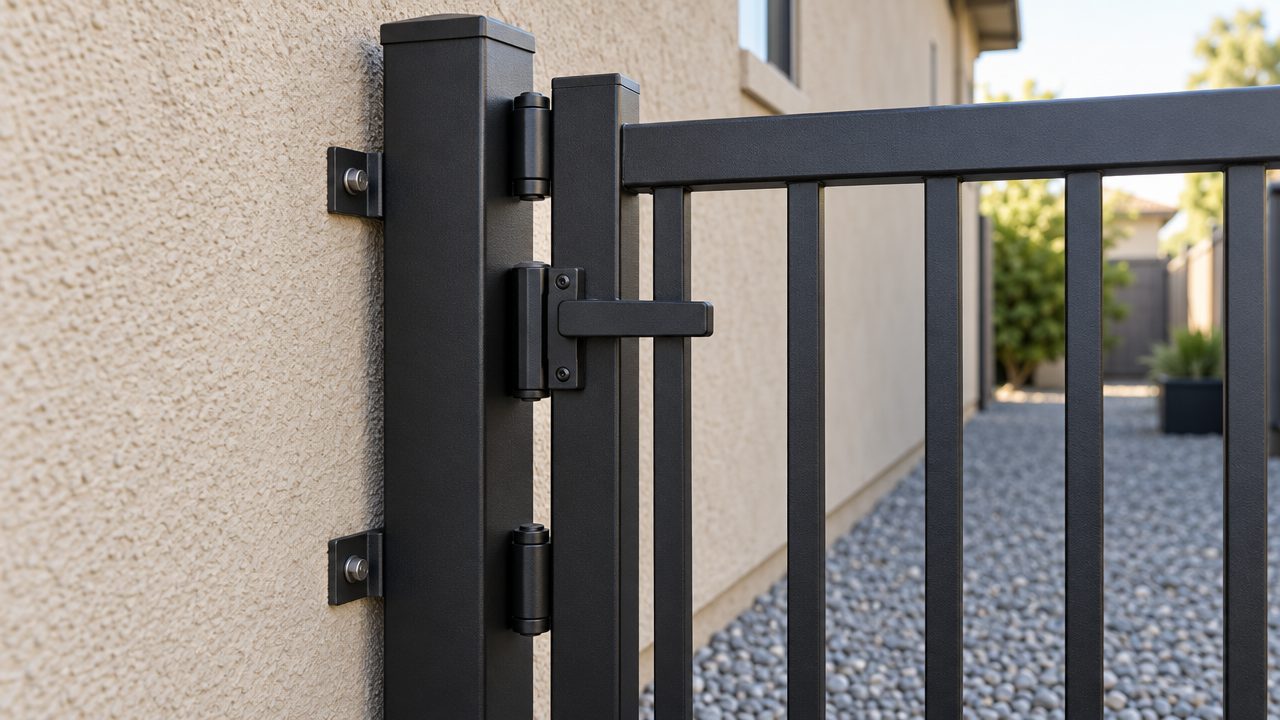
For the building, put expansion joints at wall intersections and material transitions, and separate brickwork from dissimilar materials with building paper, flashing or polyethylene sheeting. So a brick or block garden wall should stop at the house with a sealed movement joint, detailed by the mason, rather than being bonded into the house wall. If a metal gate post has to fix to the house, attach a metal gate to a house wall covers fastening through stucco without letting water in.
What should I check before building?
- The core. Block or concrete, not studs behind plaster.
- Add-ons within 5 feet of the house. Caps, trellis, the gate: each is judged on its own.
- For fiber cement, the product’s E136 report and metal framing.
- Your city’s masonry permit height, which may be 3.5 feet, plus zoning limits.
The full definition and the list of other materials are on what counts as noncombustible. The Class A ratings on fiber cement data sheets come from ASTM E84, a flame spread test; the Zone 0 definition turns on E136, so ask for the E136 result.
Questions people ask
Is concrete non combustible?
Yes. Concrete, concrete block, brick and natural stone are noncombustible. California's Zone 0 rule defines noncombustible by the ASTM E136 furnace test, and plain concrete and masonry are treated as noncombustible without a product test report, so a block or brick wall can form the 5 feet at the house.
Is stucco non combustible?
The plaster is. A stucco wall counts as noncombustible when it covers block or poured concrete. Over wood studs it does not, because the WUI Code 501.4.1 exception for surfaced materials requires a structural base of noncombustible material.
Is fiber cement fireproof?
Fireproof is not a code term. James Hardie siding, Allura cladding and American Fiber Cement panels all have ASTM E136 passes on file, but those results cover siding and cladding, not fence boards, so ask the maker whether the result applies to the board you would use.
Keep reading


More in Noncombustible materials
Spot an error? Tell us and we will correct it and note the change.