In this article (12)
Steel, aluminum, concrete and masonry are the usual noncombustible examples; wood, vinyl and wood-plastic composite are combustible, and “fire-resistant” or “fire-retardant” on a label does not mean noncombustible. The rest of this page covers the exact wording, the test, common fence and yard materials, and what to hand an inspector.
What does noncombustible mean in the Zone 0 rule?
The Board’s rule defines it in one sentence (14 CCR 1298.02(f) for the Local Responsibility Area, 1299.02(g) for the State Responsibility Area):
“Noncombustible. Materials that pass the American Society for Testing and Materials (ASTM) E136 test, thus meeting the standard for ‘noncombustible materials’ described in Section 501.4.1 (and any amendments thereto) of Title 24, Part 7 of the California Wildland-Urban Interface Code.”
The same rule defines “Combustible” as “Vegetative, wood, or other materials that are likely to ignite and transmit flames in a wildfire.” The April 2026 draft left the term undefined. The Board’s July 2026 staff memo says commenters asked for the WUI Code definition and that staff added it “to provide greater clarity and consistency for property owners, inspectors, and local jurisdictions.”
The rule is adopted but not in force. The Board filed it with the Office of Administrative Law (OAL) on 28 August 2026 (file 2026-0828-03E) and withdrew it on 8 September 2026, before OAL ruled. On 10 November 2026 OAL’s under-review list had no Board of Forestry entry. See is the Zone Zero law in effect for the latest.
What does WUI Code Section 501.4.1 say?
Section 501.4.1 of the 2025 WUI Code has a main rule and one exception:
- Main rule. “Materials required to be noncombustible shall be tested in accordance with ASTM E136 and pass the test.” A second route is allowed: testing under ASTM E2652 “using the acceptance criteria prescribed by ASTM E136.”
- Exception for thin surfacing. A material with “a structural base of noncombustible material” and “a surfacing of not more than 0.125 inch (3.18 mm) in thickness having a flame spread index not greater than 50 when tested in accordance with ASTM E84 or UL 723 shall be acceptable as noncombustible.”
Section 501.4 adds a durability condition: a material cannot be classed as noncombustible “if it is subject to an increase in combustibility or flame spread beyond the limitations herein established through the effects of age, moisture or other atmospheric conditions.”
In our reading, the exception is what a powder-coated or painted metal fence relies on: the metal passes E136 and the coating is thin with a low E84 flame spread. The rule does not say this in so many words, and an inspector will make the call.
How does the ASTM E136 test work?
The Aluminum Association’s fire-safety paper (undated, accessed 10 November 2026) summarizes the method. A sample goes into a vertical tube furnace at 750 C and stays until it fails or 30 minutes pass. At least four samples are tested and three must pass. A sample passes if:
- it loses 50% of its weight or less, the furnace temperature rises no more than 30 C (54 F) above the stabilized starting temperature, and no flaming is seen after the first 30 seconds; or
- it loses more than 50% of its weight, the furnace temperature never goes above the stabilized starting temperature, and no flaming is seen at any time.
In plain terms, the test measures whether the material adds heat or flame to a hot furnace. Whether it survives, holds its shape or keeps its strength is outside the test.
Is noncombustible the same as fire-resistant or ignition-resistant?
No. The three terms come from different parts of the code, and only the first is in the Zone 0 definition.
| Term | What it means in California code | Test | Counts as noncombustible for Zone 0? |
|---|---|---|---|
| Noncombustible | Passes the tests in WUI Code 501.4.1 (501.4) | ASTM E136, or E2652 with E136 criteria | Yes |
| Ignition-resistant | A WUI Code category for exterior materials (503.2) that includes noncombustible materials, fire-retardant-treated wood, and other materials with a flame spread index of 25 or less in a 30 minute extended ASTM E84 test | Extended E84 or E2768 | Only the noncombustible subset |
| Fire-resistance-rated | How long a wall, floor or other assembly holds up in a fire (501.3) | ASTM E119 or UL 263 | No; it rates assemblies, not materials |
“Fire-resistant” is not one of these defined categories, so on a product page it does not tell you which test, if any, was passed. Fire-retardant-treated wood is listed in WUI Code 503.2.2 as an ignition-resistant material. It is still wood, which the Zone 0 rule names in its definition of Combustible.
Which fence and yard materials pass, and which fail?
The Zone 0 rule names no specific materials. The list below combines the rule’s definition with what the Board’s guidance, IBHS, NIST, Fire Safe Marin and UC ANR say. A product-specific E136 report beats any general list.
Generally noncombustible
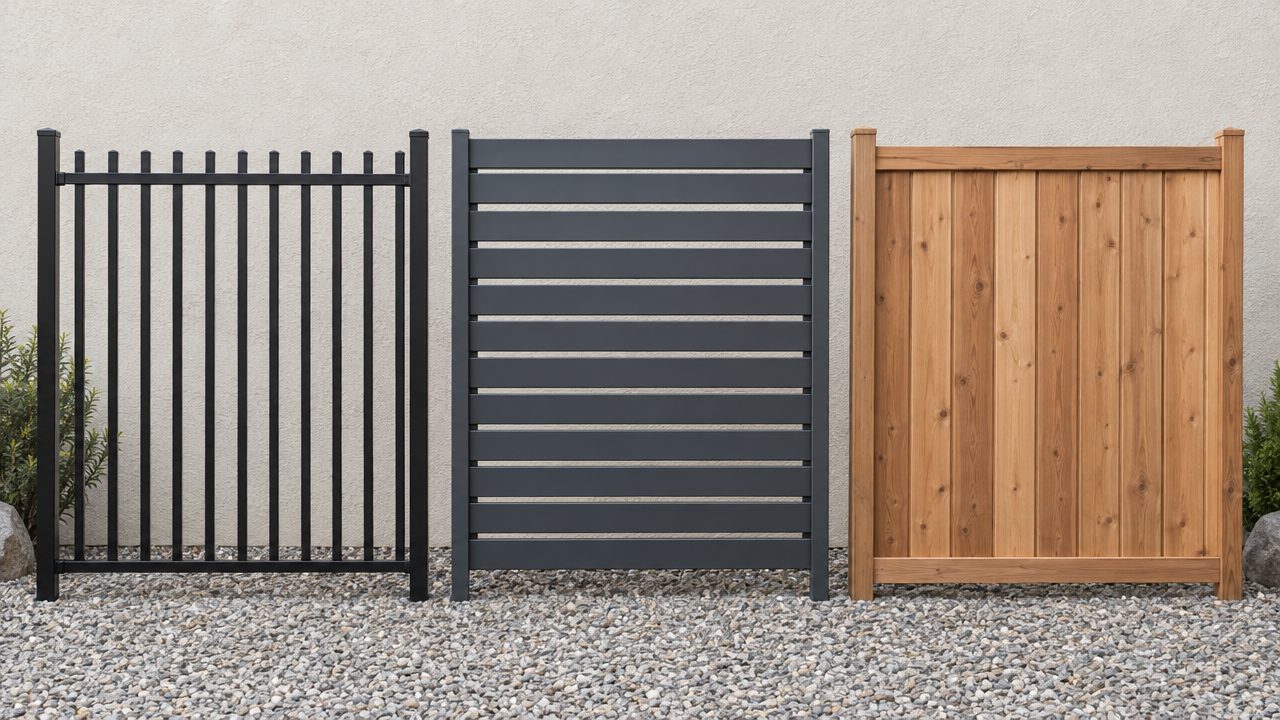
- Steel and iron. The Board’s guidance tells owners to “Replace the first 5 feet of attached fences with metal or non-combustible materials.” Fire Safe Marin lists steel fencing among “the strongest options.” NIST’s 2022 report names steel with stone and brick as noncombustible fence materials.
- Aluminum. The Aluminum Association reports that nine alloys and commercially pure aluminum passed E136 in tests run in 2011 and 2020. It melts at about 660 C (1220 F), which is a separate question from burning. Details in is aluminum noncombustible.
- Concrete, block, brick, stone and stucco. UC ANR names “steel or concrete” for noncombustible fences. The IBHS 2026 checklist lists brick, masonry veneer and stucco as noncombustible siding, and concrete, tile, stone and pavers for noncombustible decks.
- Fiber cement. IBHS lists fiber cement as noncombustible siding, and Fire Safe Marin calls fiber cement fencing “another strong choice.” Fire Safe Marin notes it is made of “cement, sand, and cellulose fibers,” so ask for the specific product’s E136 result.
- Rock mulch, decomposed granite, sand, pavers and natural stone for ground cover. The Board’s guidance suggests them for Zone 0 and says weed cloth under rock mulch is allowed.
Combustible
- Wood, including redwood and cedar. Named in the rule’s definition of Combustible.
- Fire-retardant-treated wood. Ignition-resistant under the WUI Code, not noncombustible. San Diego’s local Zone 0 guidelines (Rev. 4/22/2026) allow new treated wood listed in the State Fire Marshal’s WUI Products Handbook only for a fence running parallel to the house at least 4 feet away, which shows how narrowly it is accepted.
- Vinyl (PVC). Fire Safe Marin: “it is also a combustible material.” UC ANR: “Vinyl fences would likely melt during fire conditions.” See is vinyl fence fire resistant.
- Wood-plastic composite. NIST found that “Rapid fire growth and large flames were found for parallel fences and one type of wood-plastic composite fence,” and recommends replacing wood and composite fences near homes because fire spread is more likely with them “than with fences made of vinyl or noncombustible materials such as stone, brick, or steel.”
Depends on the build
- Hog wire. The wire is metal, but if the frame or posts are wood, the fence has combustible parts. UC ANR lists “wooden frame with metal wire” among common fence types. Fire Safe Marin says “it is not recommended to use hogwire as a gate connecting to a structure, as it does not meet Zone 0 standards.”
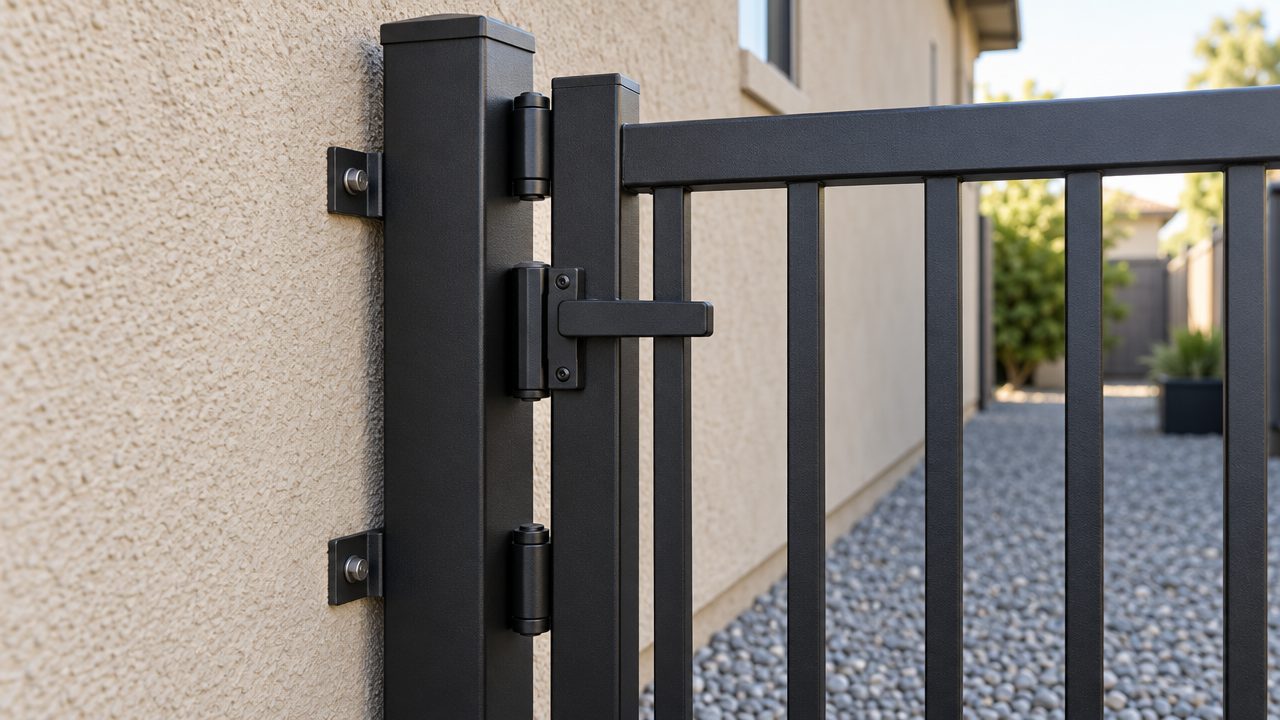
- Metal gate on wood posts. A metal panel hung on a wood post at the house wall leaves wood inside the 5 foot span the rule would require. In our reading, every part in the span, posts included, needs to be noncombustible.
Where does the Zone 0 rule require noncombustible materials?
Four places in the 19 August 2026 text, quoted from the LRA section (the SRA section, 1299.03, matches closely). All of them apply only once the rule takes effect:
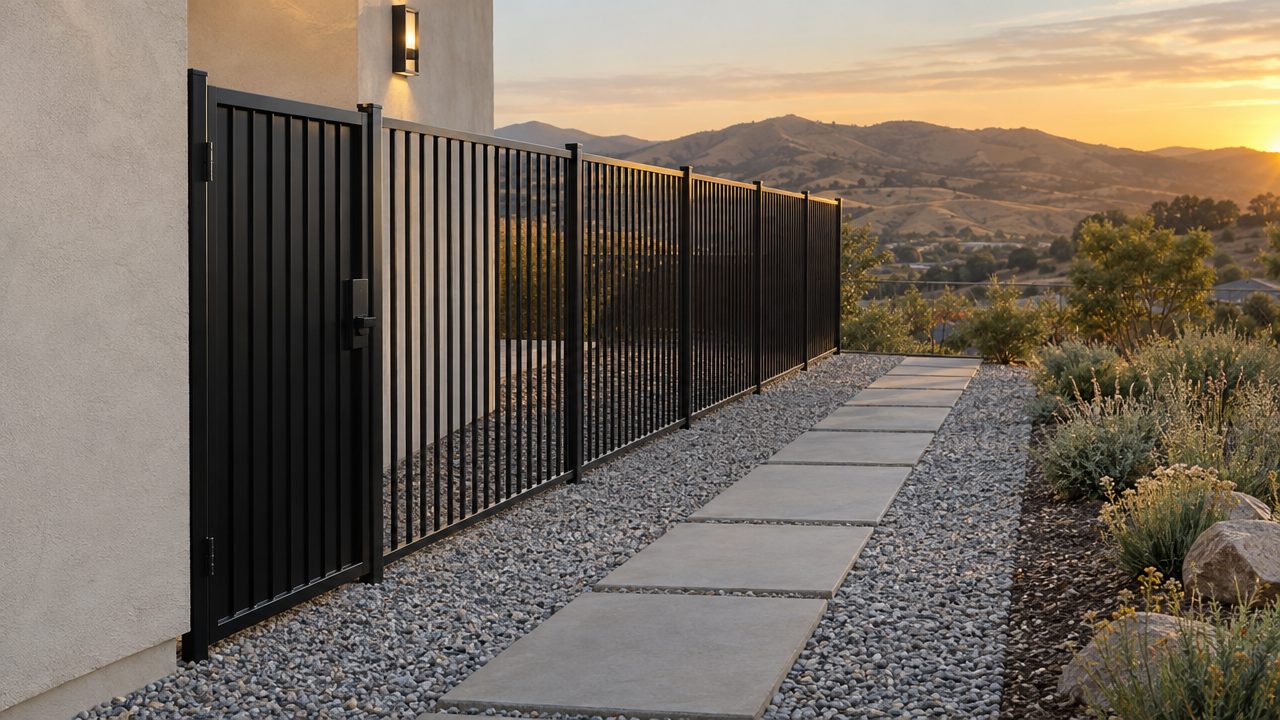
- Fences and gates. Any fence or gate attached to the house or within 1 foot of it “shall have a five (5) foot Noncombustible span from the point of attachment or the point closest to the Occupied Structure” (1298.04(b)(9)(A)). The full fence rules are in our Zone 0 fence requirements guide.
- Outbuildings. “Outbuildings are not permitted in Zone 0 unless they are constructed entirely of Noncombustible materials” (1298.04(b)(10)). Outbuildings are defined as under 120 square feet and not used for habitation.
- Pots. Plants up to 18 inches tall are allowed in “unaffixed, Noncombustible pots or containers that are no larger than five (5) gallon capacity” (1298.04(b)(7)(C)).
- Patios. The definition of Occupied Structure includes attached decks, stairs and pergolas “but does not include patios made of Noncombustible materials.” In our reading, a concrete or stone patio therefore does not move the start of Zone 0 outward the way an attached deck does.
Beyond those, the rule’s general line is that “no Combustible materials are permitted within the full 5 feet of Zone 0,” with exceptions for limited plants and lawns (1298.04(b)(1)).
How would an inspector check that a material is noncombustible?
The rule sets up no approval or listing program for Zone 0 products, so a “Zone 0 approved” label does not refer to any state approval. We expect inspectors to accept obvious cases (a block wall, a steel gate) on sight and to ask for paperwork on anything less obvious, but that is our expectation, not a written procedure. The Board’s guidance says Zone 0 “will be enforced like other defensible space requirements,” which means local fire authorities in LRA Very High zones and CAL FIRE in the SRA, where state law bars CAL FIRE from changing Zone 0 enforcement until the State Fire Marshal finds the Legislature has funded it.
What to keep on file:
- An ASTM E136 report for the material, from the manufacturer, naming the product or alloy. If it was tested to E2652, the report should say the E136 acceptance criteria were used.
- An ASTM E84 or UL 723 result for any coating, with its thickness, so the 501.4.1 exception can be checked (flame spread index of 50 or less, surfacing 0.125 inch or thinner).
- A spec sheet showing every component, including posts, rails and filler panels, so nothing combustible sits inside the 5 foot span.
None of the seven fence sellers and sites we reviewed in November 2026 published an E136 report for a specific fence product. Asking for one is the quickest way to separate a tested product from a marketing claim. Our best fire resistant fence comparison applies the same test to the options on the market.
Does a noncombustible fence survive a wildfire?
Passing E136 means a material does not feed the fire. It says nothing about warping, melting or losing strength. NIST’s 2022 report expected “Low fire hazard” from noncombustible fences, “with maintenance required to minimize the accumulation of fine combustible materials along the fence.” Leaves and needles piled against a metal fence can still burn. The Board’s guidance says the same about any fence: “Remove vegetation and combustible materials in contact with the fence.”
What could still change?
- Whether the definition survives resubmission. If the Board revises the rule before sending it back to OAL, the wording could change. We will update this page against the text OAL approves.
- How inspectors will treat coated metals under the 501.4.1 exception, and whether they will ask for paperwork on common materials.
- Local versions. Under AB 1455 (Chapter 731, Statutes of 2025), cities and counties may adopt stricter rules or alternatives with “substantially similar practical effects,” so local definitions could add detail.
Questions people ask
What materials are considered non combustible?
Under the Zone 0 rule the Board of Forestry adopted on 19 August 2026 (not in effect as of 10 November 2026), a material is noncombustible if it passes the ASTM E136 test described in Section 501.4.1 of the California Wildland-Urban Interface Code. Steel, aluminum, concrete, stone and brick are the usual examples. Wood, vinyl and wood-plastic composite are not.
Is concrete non combustible?
Fire-safety sources treat concrete as noncombustible. UC ANR names steel or concrete as noncombustible fence materials, NIST lists stone, brick and steel, and the IBHS checklist lists concrete among noncombustible deck materials. For a specific product, the test that settles it under the Zone 0 rule is ASTM E136.
Is stucco non combustible?
The IBHS Wildfire Prepared Home checklist lists stucco, with brick, fiber cement, masonry veneer and metal, as noncombustible siding. The Zone 0 rule itself names no materials; it relies on the ASTM E136 test in WUI Code Section 501.4.1.
Is fiber cement fireproof?
Fireproof is not a code term, but fiber cement is widely treated as noncombustible. IBHS lists fiber cement as noncombustible siding and Fire Safe Marin calls fiber cement fencing a strong choice. Because it contains cellulose fibers, ask the maker for the product's ASTM E136 result before relying on it inside Zone 0.
Is composite fencing fire resistant?
Not in the Zone 0 sense. Wood-plastic composite contains wood, which the rule's definition of Combustible names outright, and in NIST's 2022 fence experiments one type of composite fence showed rapid fire growth and large flames. Composite is not a noncombustible option for the first 5 feet.
Keep reading
 Is aluminum noncombustible? What the E136 tests show
- Is vinyl fence fire resistant? What Zone 0 means for PVC
 GuideBest fire resistant fence for Zone 0: materials compared
 GuideZone 0 fence requirements in California
 Is Zone Zero a law in California? Status on Nov 10, 2026
More in Noncombustible materials
Sources
- Board of Forestry, Zone 0 regulation summary and rule text as approved (14 CCR 1298 et seq., 1299 et seq.), .
- Board of Forestry staff clarification memo on Zone 0 (July 23, 2026 workshop), .
- Board of Forestry, Zone Zero Guidance Document (dated September 2026, adopted 19 August 2026), .
- California Wildland-Urban Interface Code 2025, Chapter 5 (Sections 501.3, 501.4, 503.2), .
- OAL, Emergency Regulations Under Review (no Board of Forestry entry when checked), .
- OAL, Recent Actions Taken on Emergency Regulations (file 2026-0828-03E, withdrawn 8 September 2026), .
- Aluminum Association, Fire Safety of Aluminum and Its Alloys (undated; accessed), .
- NIST Technical Note 2228-upd1, Wind-Driven Fire Spread to a Structure from Fences and Mulch (Butler, Johnsson and others), .
- IBHS Wildfire Prepared Home 2026 checklist, .
- Fire Safe Marin, Fences, .
- UC ANR Fire Network, Fence, .
- AB 1455 (Bryan), Chapter 731, Statutes of 2025, .
- San Diego Fire-Rescue, Zone 0 Guidelines for Existing Structures (Rev. 4/22/2026), .
Spot an error? Tell us and we will correct it and note the change.