
In this article (10)
The same answer covers iron. For a steel fence, the details that matter are the coating, the posts and anything bolted to the steel.
What makes a material noncombustible under the Zone 0 rule?
A test. The Board of Forestry’s rule (14 CCR 1298.02(f) and 1299.02(g)) counts a material as noncombustible if it passes ASTM E136, the furnace test Section 501.4.1 of the California Wildland-Urban Interface (WUI) Code uses. Steel is not named anywhere in the rule. What counts as noncombustible explains the definition and the test.
Does steel pass ASTM E136?
Yes. Steel is classed as noncombustible and melts far above the test temperature, though steel fence makers rarely publish a product E136 report. In E136, a sample sits in a furnace held at 750 C (1382 F) for up to 30 minutes, and it fails if it raises the furnace temperature too far or flames.
- Cold-formed steel framing is noncombustible.
- NIST’s 2022 fence report puts steel fences with stone and brick in its low fire hazard group.
- The Wildfire Prepared Home standard, which some insurers credit, allows only noncombustible materials within 5 feet of the home, such as metal (aluminum, steel, chain link, iron), concrete, masonry or stone, posts and gates included.
For bare steel the missing product report matters less than it does for coated or composite products.
Does the E136 melting limit apply to steel?
No. The scope of ASTM E136-24a, the edition the California WUI Code cites, says the method “is not suitable or satisfactory for materials that flow, melt, or intumesce.” Carbon steel melts at 1,425 to 1,540 C, roughly 675 C or more above the 750 C furnace, so bare steel does not melt during the test and the limit does not reach it. Aluminum, which melts at about 660 C, is the metal it does reach; see is aluminum noncombustible.
Does galvanizing or paint change the answer?
Paint and powder coat raise a different scope limit. Section 1.2.1 of E136 says the method “does not apply to laminated or coated materials,” so a test of a painted panel cannot show it is noncombustible. Instead, WUI Code 501.4.1 accepts a noncombustible base with a surface layer no thicker than 0.125 inch (3.18 mm) and a flame spread index of 50 or less under ASTM E84 or UL 723. Painted or powder-coated steel qualifies through that exception: the steel is the base, and the coating needs an E84 result and a thickness. The rule does not mention coatings, and the local inspector makes the call. The full explanation is in is powder coated aluminum noncombustible; the logic is the same for steel.
Galvanizing is a layer of zinc, which is itself a metal. Neither the rule nor the WUI Code says anything specific about it. Zinc is a coating in the ordinary sense and E136 does not apply to coated materials, so ask your inspector how it will treat a bare galvanized fence. Zinc melts at about 420 C, well below steel, so the zinc may be damaged in a hot fire while the steel underneath holds. Galvanized steel with paint or powder coat on top is called a duplex system.
How each common steel finish lines up:
| Steel as sold | What has to pass | What to ask for |
|---|---|---|
| Bare or rusted carbon steel | Steel only, E136 | Nothing beyond confirming it is steel |
| Weathering (corten) steel | Steel only; the patina is the steel itself | Nothing for fire; ask the supplier about coastal service life |
| Hot-dip galvanized, no paint | Steel plus a zinc metal layer; neither the rule nor the WUI Code addresses zinc | Ask your inspector |
| Painted or powder coated | Steel base, plus coating 0.125 in or thinner with E84 flame spread 50 or less | The coating’s E84 result and thickness |
| Galvanized plus paint (duplex) | Same as painted: the paint is the surface layer | The paint or powder’s E84 result |
| Steel with plastic or wood inserts | Each insert on its own; plastic and wood fail | Remove inserts from the first 5 ft |
Two cautions:
- Section 501.4 says a material is not noncombustible if it becomes more combustible with “age, moisture or other atmospheric conditions.” Rust does not make steel more combustible.
- A “fire-rated” coating on a combustible base does not make it noncombustible, and fire-rated coatings do not count for the 0 to 5 foot zone under the Wildfire Prepared Home standard either.
Is corten steel noncombustible?
Yes, in the same way as other steel. Corten is the common name for weathering steel, which is formulated with small amounts of copper, chromium, nickel, silicon and phosphorus to grow a protective patina that takes the place of paint. Because it is sold bare, there is no coating to check, which makes it one of the simplest options for a solid panel in the first 5 feet.
The trade-offs are cosmetic and practical. The surface rusts like ordinary steel at first, and the patina forms through cycles of wetting and drying, usually over 2 to 6 years. If you live near the ocean, ask the supplier about coastal service life.
How does steel compare with aluminum in a fire?
Neither burns, and steel holds up to more heat. Carbon steel melts at 1,425 to 1,540 C, above the 2,200 F (about 1,200 C) the USGS gives for extreme wildfires. Aluminum melts at about 660 C (1220 F). Melting adds no fuel, and aluminum alloys have passed E136 in lab reports, but E136’s scope excludes materials that melt, so aluminum’s standing under the rule is less settled than steel’s (is aluminum noncombustible).
The choice usually comes down to corrosion, weight and cost. Galvanized steel within a mile of the coast has in some cases rusted within 5 to 7 years on surfaces facing the ocean, while aluminum does not rust. The full comparison is in steel vs aluminum fence.
Where does a steel fence matter under the rule?
Within 5 feet of the house. Any fence or gate attached to the house, or within 1 foot of it, needs “a five (5) foot Noncombustible span” starting at the house (14 CCR 1298.04(b)(9)(A); 1299.03(d)(9)). A steel gate or panel is one way to meet it. From the effective date, no new combustible fence or gate can go in within 5 feet. Existing attached fences get 3 to 5 years after the rule takes effect (dates).
Steel helps beyond the house end too: a solid noncombustible perimeter fence, such as steel or concrete, is an effective barrier against radiant heat from a fire front.
What should I check before buying a steel fence for Zone 0?
- Every part in the first 5 feet is metal. Posts, rails, hinges and latches. A steel panel on a wood post leaves wood in the span.
- The coating’s E84 result and thickness for any paint or powder coat, so the 501.4.1 exception can be checked.
- For galvanized steel without paint, ask your local fire agency how it will treat the zinc layer, since neither the rule nor the WUI Code addresses it.
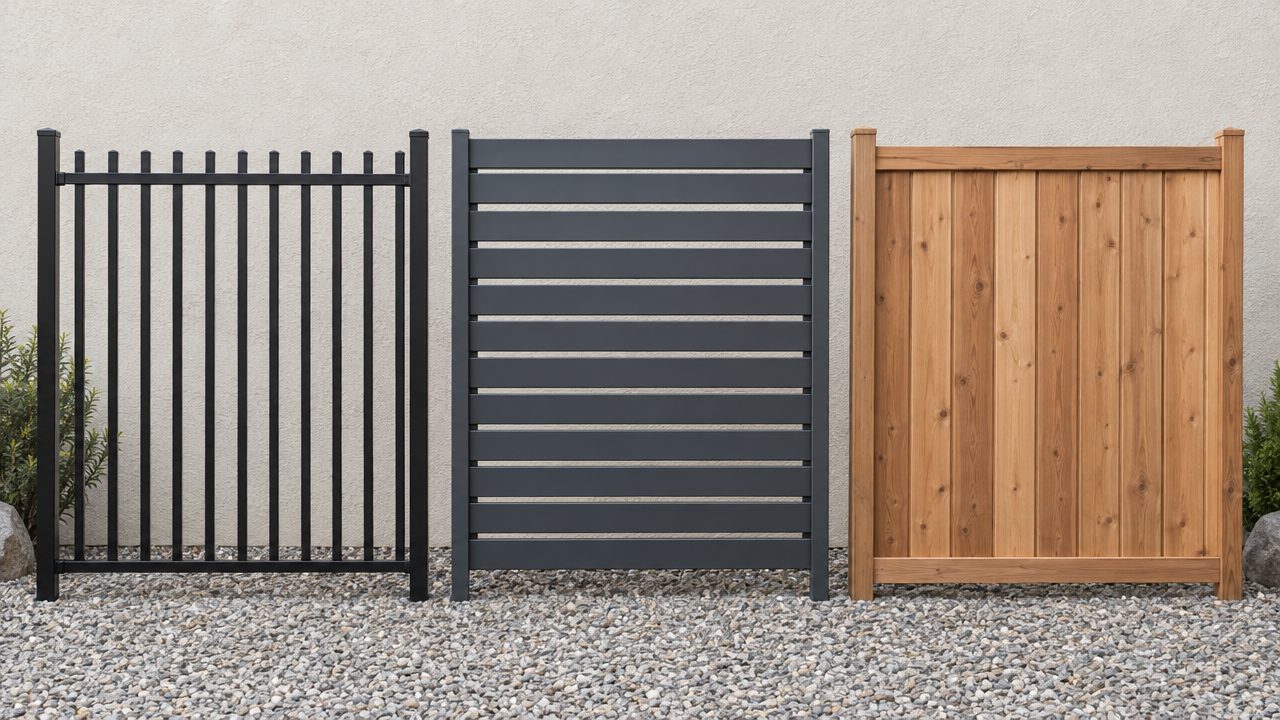
- No plastic or wood inserts. Privacy slats, wood-look boards and composite infill are separate materials; chain link and hog wire fences covers the slat problem.
- Clear ground at the base. Noncombustible fences still need maintenance to keep fine fuel from building up along them.
Inspectors may accept ordinary painted steel as metal on sight, but get the coating’s E84 sheet when you buy, so you have it if one asks.
Questions people ask
Is metal noncombustible?
Solid structural metals are treated as noncombustible. Aluminum, steel, chain link and iron are all accepted noncombustible fencing for the first 5 feet. Steel and iron melt far above the 750 C ASTM E136 test. Aluminum alloys have passed E136 in lab reports, but aluminum melts below 750 C and the standard says it is not suitable for materials that melt, so that case is unsettled. Coatings, plastic inserts and wood posts have to be checked on their own.
Keep reading

More in Noncombustible materials
Spot an error? Tell us and we will correct it and note the change.