
In this article (9)
What to check this weekend: the post at the house wall, the gate frame and any privacy slats within 5 feet of the house. If all three are metal, there is nothing to change. Other fence materials are compared in best fire resistant fence.
What does the Zone 0 rule require of a chain link or hog wire fence?
The rule treats every fence the same way, by material. Under the rule, any fence or gate attached to the house, or ending within 1 foot of it, needs “a five (5) foot Noncombustible span” next to the house (14 CCR 1298.04(b)(9)(A)). New combustible fences within 5 feet are banned from the day the rule takes effect. Existing attached fences get 3 to 5 years (dates), and parts more than 5 feet from the house are not affected. The full wording is on Zone 0 fence requirements.
Noncombustible means it passes a lab test called ASTM E136 (what that means). Bare steel passes. The rule does not mention coatings, slats or fence frames by name, so your local inspector makes the call on those parts.
Is galvanized chain link noncombustible?
Yes. Chain link fabric is woven steel wire, and steel is noncombustible (is steel noncombustible). The Wildfire Prepared Home standard, which some insurers use, names chain link among acceptable fencing within 5 feet of the home and counts posts and gates in that zone too.
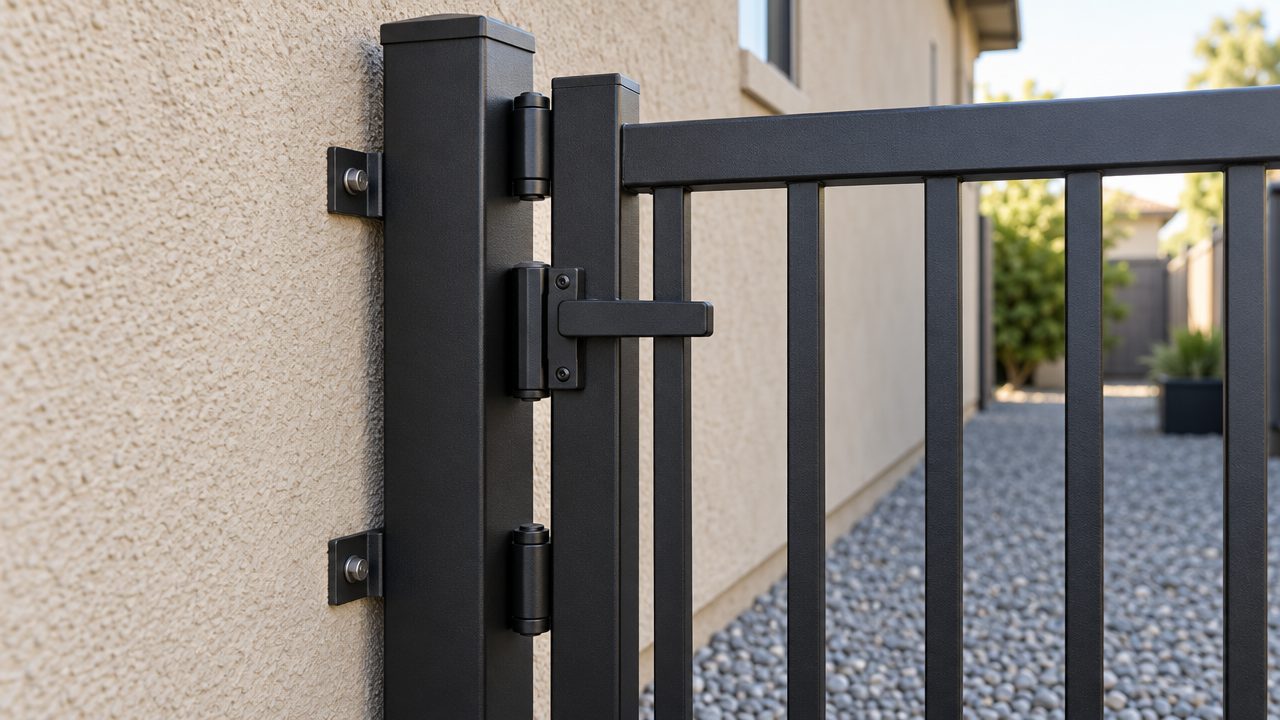
So check more than the fabric. The line posts, the terminal post at the house, the top rail and the gate frame should all be steel. A run that ends on a wood post at the wall leaves wood in the 5 foot span.
Chain link is also cheap: about $9 to $40 per foot installed, nationally. It gives no privacy, which is why so many owners add slats.
Does vinyl-coated chain link count as noncombustible?
Probably, but the coating’s flame spread figure is the missing piece. Black or green vinyl-coated chain link is galvanized steel wire with a bonded PVC coating. Fabric made to ASTM F668 (the standard for PVC-coated chain link) carries a PVC coating up to 0.010 inch (0.25 mm) over a galvanized steel core.
WUI Code Section 501.4.1, which the rule cites, accepts a noncombustible base with a surface layer up to 0.125 inch thick if that layer has a flame spread index of 50 or less under ASTM E84 (coatings). A 0.010 inch PVC layer is well under the thickness limit. Spec sheets rarely give an E84 figure, so the flame spread half of the test is usually unproven. Ask the supplier for the coating’s E84 result before using it at the house end.
Can I put privacy slats in a chain link fence in Zone 0?
Not plastic ones within 5 feet of the house. Slats are usually high-density polyethylene (HDPE) or PVC, and privacy tape is usually low-density polyethylene. Those are separate plastic parts woven through the mesh, so the exception for thin coatings on metal does not cover them. They fit the rule’s definition of combustible: materials “likely to ignite and transmit flames in a wildfire.”
Ways to keep the privacy:
- Leave the first 5 feet from the house unslatted, or use aluminum slats there; ask for the coating’s E84 result.
- Switch the house end to a solid metal panel or gate. Fire resistant privacy fence compares solid steel, aluminum slat and masonry options.
Slats farther than 5 feet from the house fall outside the rule.
Is hog wire fence fire resistant?
The wire is, and a wood frame is not. Hog wire (welded wire) panels are metal mesh, and a common build sets them in wood posts and rails. A wood frame with metal wire gives good protection from flame spread along the fence, but none against embers or radiant heat. The wire panels do not make the continuous combustible surface of a solid wood fence, though any wood posts, rails or framing still need regular attention.
At the house end, a hog wire gate connecting to the house does not meet Zone 0 standards in its usual wood-framed form. A hog wire panel in a welded steel frame on steel posts is all metal and meets the definition.
You do not need to replace the whole fence. Only the first 5 feet, or the gate at the house, has to change (wood fence attached to house).
What do I have to change on my fence?
| Your fence | Within 1 ft of the house or attached | Within 5 ft, not touching | More than 5 ft away |
|---|---|---|---|
| All-steel chain link (fabric, posts, rails, gate) | Nothing | Nothing | Nothing |
| Chain link on a wood end post or wood gate | Steel post and gate in the first 5 ft | Existing: nothing. New: all metal | Nothing |
| Chain link with plastic slats or tape | Pull slats from the first 5 ft, or use metal slats | Existing: nothing. New: no plastic slats | Nothing |
| Vinyl-coated chain link | Get the coating’s E84 result | Same, if new | Nothing |
| Hog wire in a wood frame | First 5 ft, or the gate, to a steel frame on steel posts | Existing: nothing, wood repairs allowed. New: all metal | Nothing |
| Hog wire in a welded steel frame | Nothing | Nothing | Nothing |
To convert a wood-framed run, end the wood at a post at least 5 feet from the house and run metal from there to the wall, posts included. Measure from the wall, or from the closest point if the fence stops within a foot of it.
Which is better at the house end, chain link or hog wire?
Either works for the 5 feet next to the house if every part is metal. With chain link, check the end post and the gate frame; with hog wire, the frame and posts. Neither is a solid barrier; a solid noncombustible fence, such as steel or concrete, is what blocks radiant heat from a fire front. Either way, keep leaves and mulch off the base. Noncombustible fences still need maintenance so fine combustible material does not build up along them.
Questions people ask
Is chain link fence OK for Zone 0?
Yes, if every part is metal: fabric, posts, top rail and gate frame. Chain link is woven steel wire, and it is accepted fencing within 5 feet of a home. On a fence that touches the house, wood end posts, wood gates and plastic privacy slats in the first 5 feet are the parts that do not meet California's Zone 0 rule.
Is hog wire fence fire resistant?
The wire is, and a wood frame is not. Hog wire panels are metal mesh, but they are often set in wood posts and rails, and that wood is combustible. A wood-framed hog wire gate connecting to a house does not meet Zone 0 standards. A hog wire panel in a welded steel frame on steel posts is all metal.
Keep reading


More in Product comparisons
Spot an error? Tell us and we will correct it and note the change.